
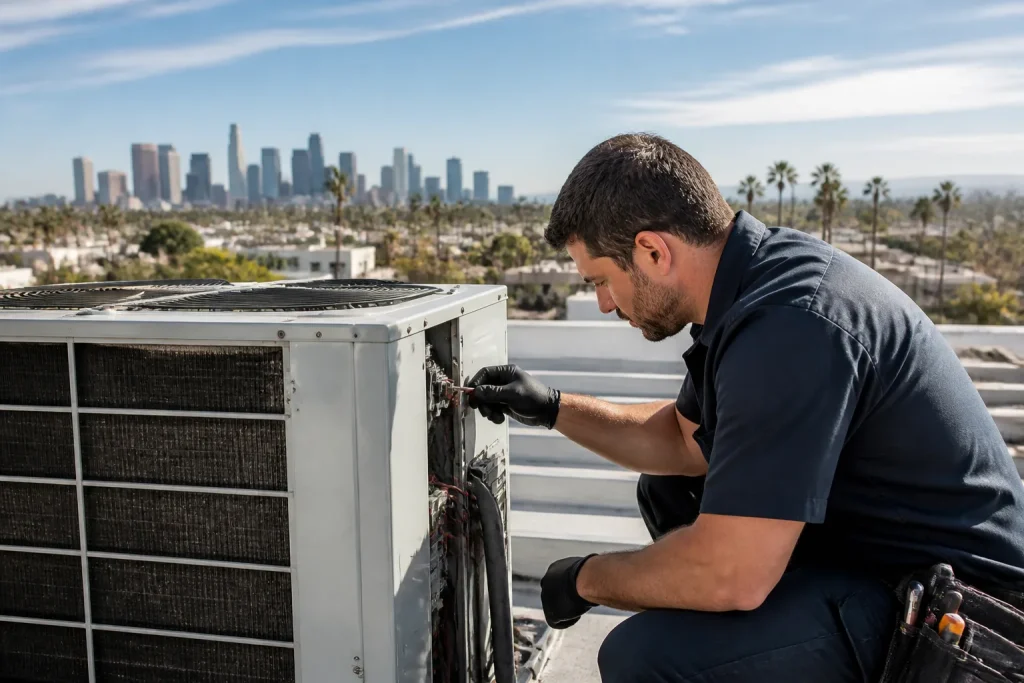
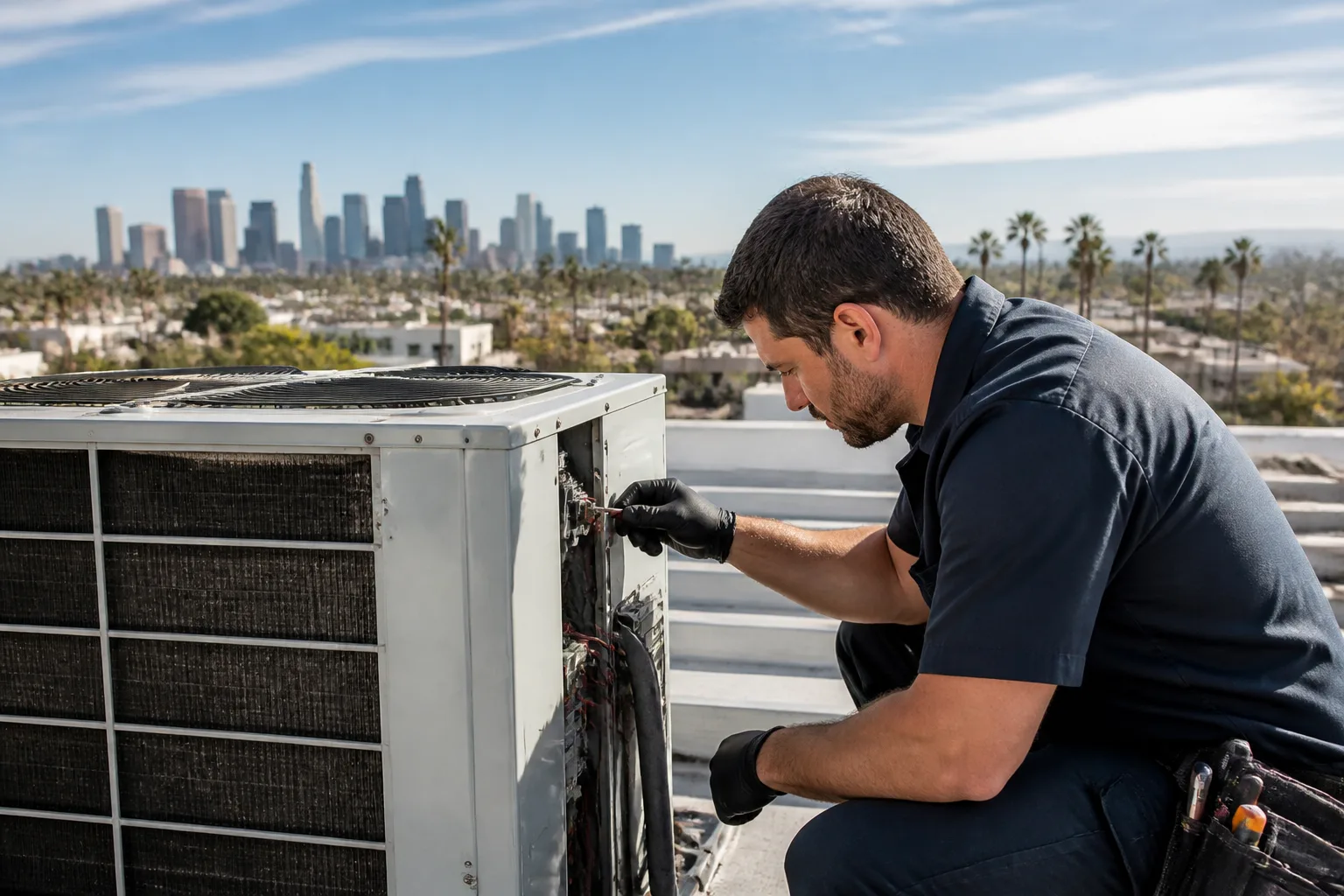
Top Signs You Need HVAC Service - Don’t Ignore These
A refrigerant leak rarely announces itself with a bang. It shows up first as a slightly warm room on a hot afternoon, which most homeowners attribute to a hot day, then to a dirty filter, then to age, until the compressor burns out entirely. The signs your HVAC system needs service are usually small, and that’s exactly why they get ignored. Knowing what to listen for, smell, and watch on your monthly bill can turn a $200 service call into a repair you catch early instead of a $2,400 replacement you didn’t plan for.
If you’d rather not sort through symptoms alone, call (747) 966-3037 and we’ll talk it through.
Key Takeaways
- Most expensive HVAC failures give six to eight weeks of warning signs before they happen.
- A sudden spike in your L.A. electricity bill during a month when you didn’t change how you use the AC is often the first measurable sign of a struggling compressor.
- Different sounds point to different failures. A metallic scrape is not the same problem as a hiss.
- If you see ice on the indoor coil, turn the system off and call before running it again.
- Uneven cooling in Los Angeles homes is frequently an airflow or duct problem, not a sign that you need a bigger unit.
What a struggling HVAC system sounds like in Los Angeles
Most of us tune out the background hum of an air conditioner. But when a system starts to fail, the sounds change in specific ways. After years of service calls around Los Angeles, we can usually name the likely problem before we open the unit, just from the noise a homeowner describes.
A metallic scraping or grinding sound often points to a blower wheel making contact with its housing. The motor mounts wear, the wheel shifts slightly, and metal touches metal. Left alone, that wheel wears through, the motor overheats, and you’re replacing both instead of one.
A hissing or bubbling noise near the indoor coil can mean refrigerant escaping as a gas or moving through a restricted line. Refrigerant doesn’t get used up, so any hiss means there’s a leak somewhere, and the system is losing its ability to move heat.
A humming that continues after you shut the system down can be a contactor that’s sticking, or a fan motor that’s seized but still drawing power. That’s a simple fix when caught early, and a burned out motor if not.
And then there’s the one that deserves immediate attention: a sulfur or rotten-egg smell is not an HVAC problem. In Los Angeles, natural gas has an odorant added so you can detect leaks. If you smell sulfur near your furnace, turn off the gas valve if you can, leave the house, and call your utility provider first, then call us. A musty smell, by contrast, is almost always microbial growth in the drain pan or on the coil, common in humid L.A. basements and closets. That’s a cleaning and drainage issue, not an emergency, but it will keep coming back if water isn’t draining properly.
Uneven cooling: duct problem or capacity problem?
When one bedroom in Los Angeles stays comfortable while another climbs to 80 degrees on the same thermostat setting, the first instinct is often: our system is too small or too old. That’s rarely what’s actually happening.
Here’s what a technician checks first, in order:
- Supply register airflow. Is air coming out of the problem room’s vent at the same force as the comfortable room’s vent? If not, the issue is usually a duct that’s disconnected, crushed, or leaking. In Los Angeles attics, ducts sag and separate at joints all the time, especially the flex duct used in many 1990s and 2000s era homes.
- Return air path. If the room’s door stays closed and there’s no return vent in that room, the air has nowhere to go. The room pressurizes, and the supply air slows to a trickle. A simple undercut door or transfer grille fixes it, not a new system.
- Dampers and zoning. Some homes have manual dampers in the ductwork that were set years ago and never adjusted. If a previous owner closed one for a reason nobody remembers, it’s been strangling that room ever since.
- System capacity. Only after airflow checks out normal do we look at whether the unit is undersized, and truly undersized systems in Los Angeles are less common than people think. Most homes we visit were built with reasonably matched equipment, and the problem is that the equipment isn’t delivering what it could.
Luis Serrano has seen this pattern repeat in neighborhoods from Sherman Oaks to Highland Park. A homeowner calls expecting a quote for a whole new system, and the actual fix is a $180 duct repair. That’s why we measure airflow before we quote anything.
When to call a pro: Airflow testing requires a manometer and experience reading static pressure. This isn’t a DIY check. If one room in your Los Angeles home is consistently fighting the others, we’ll find out why with instruments, not guesses.
The electricity bill spike that means your compressor is working harder than it should
Here’s a scenario we hear often in Los Angeles: you didn’t add a home office, you didn’t host guests, the weather was about the same as the same month last year, and yet your bill jumped 20 to 30 percent. What changed?
When a compressor starts to wear, or when the refrigerant charge is low, the system has to run longer and work harder to move the same amount of heat. That extra effort shows up directly in kilowatt hours. In our experience across the Los Angeles basin, a 20 to 30 percent increase in cooling costs during a month with comparable outdoor temperatures and identical usage patterns is often the first measurable sign of one of three things:
- Low refrigerant. The compressor runs nearly nonstop trying to hit the thermostat set point and never quite gets there.
- A failing capacitor. The compressor and fan motor struggle to start, cycling more often, each start drawing a spike of power.
- Dirty condenser coil. The outdoor coil can’t reject heat into the L.A. air because it’s coated in dust and debris, so the system runs longer to compensate.
The frustrating part is that a homeowner watching the bill might not feel any difference in the house. The thermostat still reads 74. The system just runs twice as long to hold it. Your comfort stays flat while your bill climbs. That’s why we tell our customers to compare usage, not just cost. Los Angeles Department of Water and Power and Southern California Edison both show daily kilowatt usage online. Look at last July versus this July. If the kilowatt hours jumped and your routine didn’t, the HVAC system is the first thing to check.
Related services: AC Repair in Los Angeles covers diagnostic visits, and we’ll measure refrigerant pressures, amp draw, and coil condition before we recommend anything.
Ice on the coil: what it means and why running the system makes it worse
If you see ice on the indoor evaporator coil or frost forming on the copper lines outside, something is preventing the coil from absorbing heat properly. The two usual causes are low refrigerant (the coil gets too cold because there isn’t enough refrigerant pressure) or low airflow (a dirty filter or closed vents starve the coil of warm air to heat it).
Ice might look harmless. It is not. Ice acts as an insulator. The coil stops absorbing heat, so the refrigerant returns to the compressor as a cold liquid instead of a warm gas. Compressors are designed to compress gas, not liquid. Running a frozen system can destroy a compressor, and a compressor replacement on a mid-size Los Angeles split system can run $1,800 to $2,800 depending on the brand and whether it’s under warranty.
Here’s the safe sequence if you spot ice:
- Turn the system off at the thermostat. Set the fan to “On” so warm indoor air blows across the coil and helps it thaw. Do not chip at the ice, and do not use anything hot on it.
- Check the filter. If it’s clogged, replace it. A restricted filter can cause this on its own.
- Open all the supply vents. Closed vents in unused rooms reduce airflow across the coil.
- Wait for the ice to fully melt, then call for service. If it ices up again after restarting, the system has a refrigerant or airflow problem that needs a technician’s gauge set to diagnose.
We pulled one out of a garage over in Mar Vista last spring where the homeowner had been chipping ice with a screwdriver for two days before calling. The evaporator coil looked like it had been through a hailstorm, and the repair went from a recharge to a full coil swap. The lesson: when ice shows up on an AC coil in Los Angeles, the thaw and the diagnosis are a technician’s job.
Short-cycling: when your system acts like it can’t make up its mind
Short-cycling is the term for a system that turns on, runs for a few minutes, shuts off, and restarts again shortly after. Normal operation in mild Los Angeles weather might be two or three cycles per hour. A short-cycling unit might start and stop every five to seven minutes.
The three most common causes, ranked by typical repair cost:
- Clogged filter or restricted airflow (lowest cost). The system catches heat too quickly because air isn’t moving across the coil, safety limits trip, and the unit shuts down. A $15 filter swap fixes it. This is the first thing we check because it’s the most common and the cheapest.
- Faulty thermostat or thermostat placement (moderate cost). If the thermostat sits in direct sun from a Los Angeles window, or near a heat source, it reads the room wrong and calls for cooling in short bursts. Replacing or relocating a thermostat runs $150 to $450 depending on the model and wiring.
- Oversized system or failing compressor (highest cost). An oversized unit cools the space too fast and shuts off before it has removed enough humidity, then restarts when the temperature creeps back up. A failing compressor may also overheat and trip its internal protection, then restart after cooling down. Neither is a quick fix, and both benefit from a professional load calculation and diagnosis before any money is spent.
Short-cycling shortens the life of every component in the system. Each start is the hardest moment for a compressor and a fan motor. A system that cycles twice as often wears out twice as fast. If you notice your Los Angeles home’s AC clicking on and off more than usual, note how many times in an hour, check the filter, and then call before the strain becomes a replacement.
When to call a pro: Short-cycling has multiple possible causes, and treating the wrong one won’t fix it. A technician will check static pressure, refrigerant charge, and thermostat signal to find the actual trigger. Guessing and swapping parts is the expensive way to do it.
What the small signs have in common
Every one of the signs above has the same profile: easy to notice, easy to explain away, and quietly expensive when ignored. The slightly warm room in July, the faint hiss from the closet, the bill that crept up in June and never came back down. In Los Angeles, where the AC can run seven or eight months a year, the system gets more chances to fail than it would in a milder climate. The warning signs repeat more often.
That’s why we structure our service the way we do. A written price before any work starts means you know what a repair costs before we touch a screwdriver. Shoe covers and drop cloths protect the floors and play areas where your kids and pets spend their time, and we send a photo of the clean-up before the crew pulls out of the driveway. It’s not just a courtesy. It’s the Cedarwell Care Promise: if the job isn’t done right, we make it right, with no runarounds and no fine print.
We service equipment from Trane, Lennox, Goodman, Rheem, and five other major brands, so we’re not married to one manufacturer’s parts or availability. The goal is a system that runs quietly, cools evenly, and doesn’t surprise you on the bill. That starts with catching the small signs early.
Related services in Los Angeles: Furnace Repair in Los Angeles if the symptoms show up during heating season, and AC Installation in Los Angeles if the diagnosis points to a system that’s reached the end of its service life.
The Bottom Line
Your HVAC system tells you when something’s wrong, long before it fails outright. A hiss means a refrigerant leak. A metallic scrape means a blower wheel on its way out. A musty smell means water sitting where it shouldn’t. A 25 percent jump in July kilowatt usage means the compressor is working harder than last year. Ice on the coil means shut it down and call. Short-cycling means something is tripping a limit or a sensor, and it will keep tripping until the cause is fixed.
If you’re in Los Angeles and any of these signs sound familiar, don’t wait for the system to confirm the diagnosis with a full breakdown. Meadowsweet Heating & Air home offers free estimates with a written price before any work starts. Call (747) 966-3037 and a live person will answer, any hour, any day of the week.
Frequently Asked Questions
How do I know if my HVAC system needs service or just a new filter?
A clogged filter can cause several of the same symptoms: reduced airflow, ice on the coil, short-cycling, and longer run times. Replace the filter first and run the system for a day. If the symptom goes away, the filter was the cause. If it comes back within a day or two, the system needs a technician with gauges and meters to find the real problem.
What does a failing HVAC compressor sound like?
A failing compressor in a Los Angeles home typically makes a hard-start noise (a brief, strained buzz when the system kicks on) or a rattling that wasn’t there before. The buzz usually points to a failing capacitor or a compressor struggling to start. A hissing or gurgling sound at the indoor coil is more likely a refrigerant leak. Any of these deserves a professional look before the noise becomes a replacement.
How much does an HVAC diagnostic visit cost in Los Angeles?
Diagnostic fees in the Los Angeles area typically range from $79 to $150 depending on the company and the time of day. Meadowsweet Heating & Air provides a written price before any work starts, so you’ll know the diagnostic cost and the repair estimate before you commit. Call (747) 966-3037 for an exact quote, and estimates are free.
Can a dirty condenser coil really raise my electricity bill that much?
Yes. The condenser coil is the part that dumps heat into the outdoor air. When it’s coated in dust, pollen, and the usual Los Angeles grime, it can’t reject heat efficiently. The system runs longer to move the same heat, and your bill climbs while the house stays the same temperature. We’ve seen a dirty coil account for a noticeable percentage of a summer cooling bill, and cleaning it is far cheaper than the extra electricity.
Written by Luis Serrano, Owner at Meadowsweet Heating & Air, serving Los Angeles since 2004.
Need HVAC Help?
Call Meadowsweet Heating & Air - licensed & insured, here with fast after-hours help in Los Angeles.
(747) 966-3037