
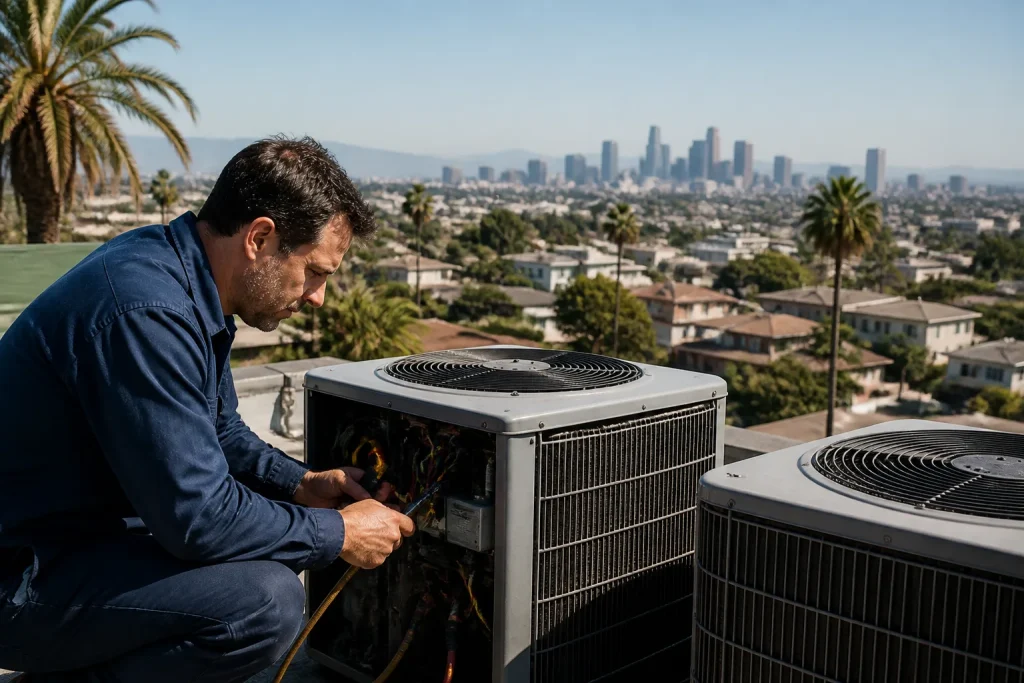
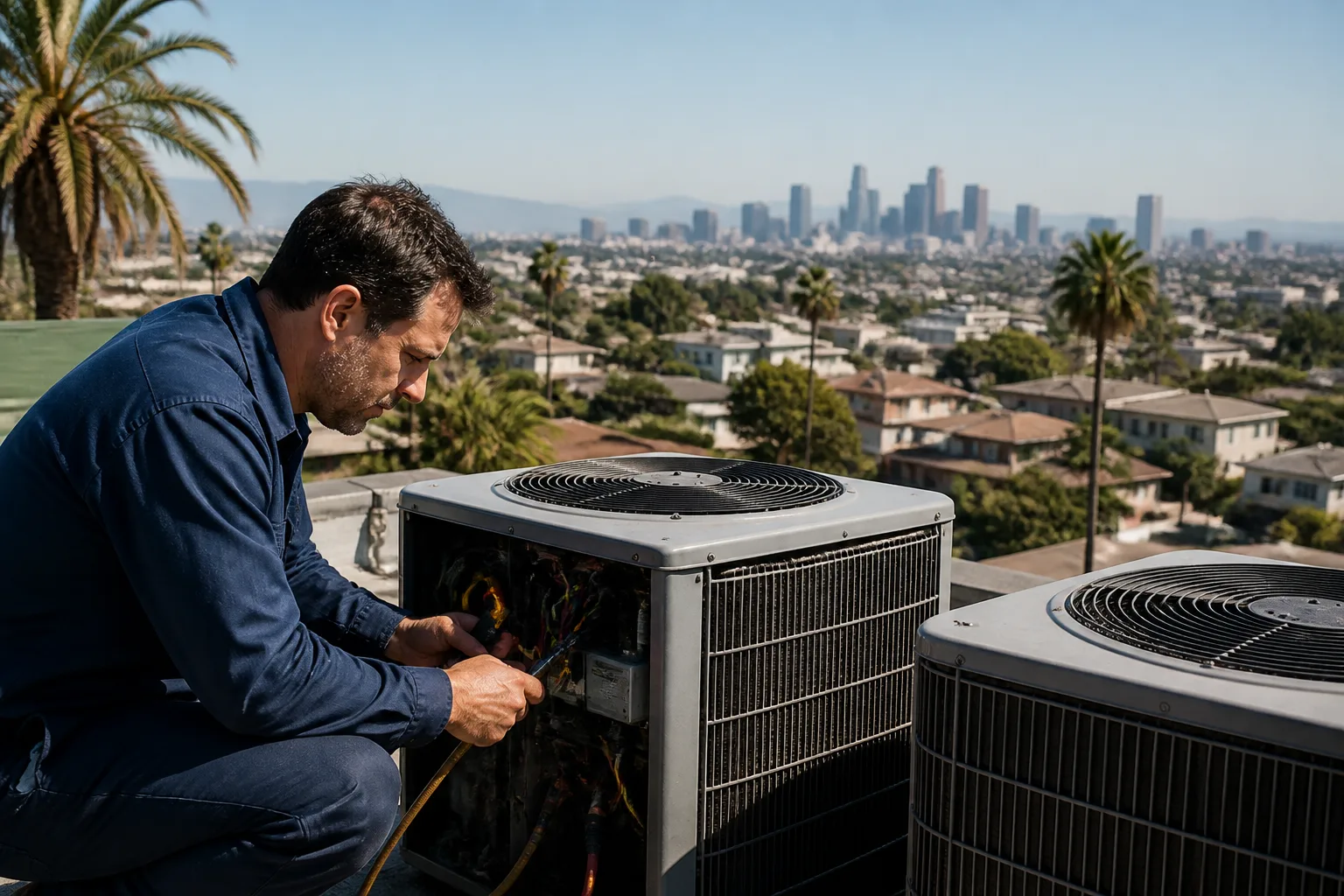
AC Repair: Repair or Replace? How Los Angeles Homeowners Decide
The repair-or-replace decision comes down to three numbers: your system’s age, the repair cost, and how many cooling days your specific Los Angeles neighborhood logs each year. A $900 compressor replacement on a 14-year-old unit in Woodland Hills, where the AC runs nine months a year, is usually money that would be better spent on a new system. The same repair on a 7-year-old unit in Santa Monica might be a perfectly sensible bridge for another three or four years. If you’d rather skip the math and get a straight answer, call us at (747) 966-3037 for a free estimate.
Here’s the thing about the “5,000 rule” you’ve probably read about. Multiply the repair cost by the system’s age, and if the total exceeds $5,000, replace it. Sounds clean. But that rule was built for Midwest climates where an air conditioner works four months a year. Your AC in Los Angeles is doing two to three times that work. A unit in Woodland Hills or Sherman Oaks with nine months of runtime ages differently than the identical unit in Pacific Palisades working half that. The math needs to be local, and that’s what this guide walks through.
Key Takeaways
- Run the real math using your neighborhood’s cooling days, not a national rule of thumb.
- Capacitor and contactor repairs are bridge repairs. Compressor failures are a signal the system is near its end.
- California’s Title 24 standards add $500 to $1,200 to a permitted replacement, but unlock rebates that can offset it.
- LADWP and manufacturer rebates currently run $300 to $3,000 depending on efficiency tier and equipment type.
- A trustworthy technician recommendation names specific measurements: refrigerant levels, amp draws, coil condition. Vague urgency is a red flag.
The Los Angeles-Specific Math: Cooling Days Before System Age
The national replacement guideline says an air conditioner lasts 12 to 15 years. That range assumes roughly 1,000 to 1,500 hours of runtime per year. In Los Angeles, runtime varies enormously by neighborhood. A system in Woodland Hills or Northridge accumulates 2,000 or more hours annually because summer temperatures routinely cross 95 degrees and the cooling season stretches from April through October. That same unit in Manhattan Beach or Brentwood might log 800 hours a year, kept mostly off by ocean air and evening fog.
What this means: a 12-year-old unit in the Valley has already done the work of a 20-year-old coastal unit. Age alone is the wrong number. The right number is total accumulated runtime, which almost no homeowner tracks, so the next best proxy is your neighborhood’s annual cooling-day count. You don’t need precision. You need the right comparison. When we evaluate a system for a repair-or-replace recommendation, we ask one question first: how many months a year does this unit actually get worked hard? The answer changes the entire recommendation, and it changes it by neighborhood in Los Angeles.
The homeowner in Woodland Hills should lean toward replacement at the 12-to-14-year mark, full stop. The homeowner in Playa del Rey can reasonably push that to 16 or 17 years, provided the repairs stay minor. This one adjustment, using cooling days instead of calendar years, will give you a more honest answer than any national formula.
Which Repairs Buy You Years, and Which Just Buy You a Summer
Not all AC repairs carry the same signal about the system’s remaining life. Some are truly isolated failures, like a dead capacitor or a pitted contactor. Those are wear parts, designed to fail. Replacing a capacitor on an otherwise healthy 9-year-old system is a genuine bridge repair. You’ll likely get three to five more good summers out of that unit. The $180 to $350 cost is reasonable money for that timeframe.
A compressor, on the other hand, is the air conditioner’s heart. When it fails, replacement typically runs $1,800 to $3,400 in Los Angeles, depending on tonnage and brand. More importantly, a compressor rarely fails alone. It fails because the system has been overworking, often due to a refrigerant leak, a failing condenser fan, or a coil that’s been shedding efficiency for years. Replacing the compressor without addressing the underlying cause means the new one fails the same way in eighteen months. And by that point, you’ve spent nearly the cost of a new system on a unit that still has every other original component.
We’ve pulled failing compressors out of systems in Burbank and Glendale where the amp draw told the whole story before we even removed the panel. The system was 13 years old, the compressor was pulling 20% more current than spec, and the homeowner had already spent $700 on refrigerant the previous summer. That’s not a bridge repair. That’s a unit asking to be retired. When a compressor replacement crosses roughly half the cost of a new system, and the system is beyond ten years old in a high-cooling-hour neighborhood, the honest recommendation is replacement.
What California’s Title 24 Adds to the Replacement Decision
If you decide to replace, California’s Title 24 building efficiency standards matter in ways most Los Angeles homeowners don’t expect. Title 24 governs what equipment can be installed in California and what a permitted installation must include. When you pull a permit for a new AC system in Los Angeles, the contractor must verify the ductwork meets minimum leakage standards, confirm the refrigerant charge is correct within spec, and in many cases install a new properly sized filter housing. These aren’t optional add-ons. They’re code.
In practice, Title 24 adds $500 to $1,200 to a permitted replacement in Los Angeles. Some of that is duct testing and sealing. Some is the administrative work of the permit itself. Some is the requirement for a Manual J load calculation before the equipment is ordered, which is actually a good thing, because it means the system is sized for your house rather than guessed. If a contractor quotes you a replacement price that seems dramatically lower than others, ask whether the quote includes Title 24 compliance and a permit. In Los Angeles, a replacement without a permit is not only a code violation, it can complicate a future home sale and void equipment warranties.
The cost sounds like bad news until you factor in what Title 24 unlocks: the rebates. A compliant, high-efficiency installation is exactly the kind of project LADWP, SoCalGas, and manufacturers subsidize. The standard is the gatekeeper to the savings.
The Rebate Math: What You’ll Actually Pay Out of Pocket in Los Angeles
Here’s where the repair-or-replace comparison gets genuinely interesting for Los Angeles homeowners. A mid-efficiency replacement might cost $9,000 to $13,000 before incentives. But the incentives currently available in Los Angeles are real money:
- LADWP residential AC rebates: $300 to $1,200 depending on the SEER2 rating and whether you’re replacing an older unit or installing new. Higher efficiency tiers pay more.
- Manufacturer rebates: Brands like Goodman and Daikin frequently run seasonal rebates of $300 to $800 on qualifying high-efficiency systems, often stackable with utility rebates.
- Federal 25C tax credit: Up to $600 for qualifying central air conditioners, which applies at tax time, not at purchase.
- SoCalGas rebates: If your replacement involves a furnace and coil, SoCalGas offers additional incentives on efficient gas furnaces that work alongside the new AC.
A homeowner in Los Angeles replacing a 14-year-old unit might see $1,500 to $2,500 in combined rebates and credits. That changes the math meaningfully. When the conversation is framed as “repair costs $2,400 and replacement costs $10,000,” repair looks tempting even when it shouldn’t. When the replacement number is adjusted to $7,500 to $8,500 after rebates, and the system is in a high-cooling-hour neighborhood with a compressor failure, the decision becomes clearer. We walk every customer through the rebate paperwork before any work is done. It’s part of the written price, which is part of how we work.
What a Trustworthy Repair-or-Replace Recommendation Sounds Like
This matters more than most homeowners realize, because the HVAC industry has a reputation problem, and sometimes it’s earned. A trustworthy recommendation from a technician is specific. It names measurements the technician actually took: “Your refrigerant charge is down 40%, which means there’s a leak, and here’s where I found oil residue at the evaporator coil.” It references the system’s age, the neighborhood’s cooling load, and the amp draw on the compressor. It discusses what the repair will and won’t fix, and what the next failure is likely to be.
A less trustworthy recommendation relies on vague urgency without measurement. “This thing could go any day” without a test to back it up. “I wouldn’t put another dollar into it” without explaining why. Pressure to decide before the technician leaves. Refusal to provide a written breakdown. These are conflict-of-interest signals, not expertise signals. A real recommendation holds up under questions: What did you measure? What made you conclude that? What happens if we wait? In our work across Los Angeles, we’ve found that customers who ask those questions get better outcomes, because they find out quickly which companies can answer them.
A repair-or-replace recommendation should also account for what’s changing in the house. If you’re adding a nursery, hosting aging parents through a Los Angeles summer, or running a home office that needs stable temperatures, those factors shift the calculus toward replacement sooner than the raw numbers might suggest. A good technician asks about them. A sales pitch doesn’t.
When to Call a Pro
If you’re getting strange noises, uneven cooling between rooms, or an electric bill that’s crept up 20% over last summer, those are diagnostics calls, not DIY moments. The system’s electrical components, refrigerant circuit, and high-voltage wiring are not things to tinker with. A trained technician can pull measurements that tell you in thirty minutes whether you’re looking at a capacitor or a compressor, and that answer changes everything.
Related services in Los Angeles: AC Repair in Los Angeles covers diagnostic and repair work, and if the numbers point toward replacement, AC Installation in Los Angeles walks through what a Title 24-compliant install looks like. If your heating side has questions too, Furnace Repair in Los Angeles follows the same honest framework. And for the full picture of who we are and how we work, start at Meadowsweet Heating & Air home.
One more thing worth knowing: at Meadowsweet, a live person answers our phone 24 hours a day, seven days a week. No voicemail queue. Nights, weekends, holidays. When your AC fails during a July heat wave in the San Fernando Valley, you get a person on the other end of the line, not a recording telling you to call back Monday. Luis Serrano built the company around that promise, along with the other standards in our Care Promise: a written price before any work starts, shoe covers and drop cloths inside the home, and a photo of the clean-up before the crew leaves. Those aren’t upsells. They’re non-negotiable, on every single job.
And yes, we’ve seen the full range. The other week we were called out to a house in Echo Park where a “recently serviced” unit had a capacitor held in with zip ties. The homeowner had paid $300 for a “tune-up” from another company two months earlier. The system was actually fine, which is the thing: the work just wasn’t done. That kind of thing is exactly why we write prices before we start and send photos of the work when we’re finished. You should never have to guess whether the repair actually happened.
The Bottom Line
The repair-or-replace decision in Los Angeles is a climate calculation before it’s a financial one. Count your cooling months. Distinguish a wear-part failure from a compressor failure. Factor in what Title 24 compliance adds, and what LADWP and manufacturer rebates subtract. Then listen carefully to how the technician talks: specifics mean expertise, vagueness means pressure. If you’re in Los Angeles and want an honest read on your system, Meadowsweet Heating & Air offers free estimates. Call (747) 966-3037. We’ll measure, we’ll show you what we found, and we’ll leave the decision to you, with a written price either way.
Frequently Asked Questions
AC repair in Los Angeles typically runs $150 to $450 for minor electrical components like capacitors and contactors, $300 to $900 for fan motors and control boards, and $1,800 to $3,400 for compressor replacement, depending on tonnage and brand. The exact cost depends on what failed, the system’s age, and whether the equipment is under warranty. Call (747) 966-3037 for a written estimate before any work begins.
In high-cooling-hour Los Angeles neighborhoods like Woodland Hills, Northridge, and Van Nuys, a central air conditioner typically lasts 12 to 15 years before major repairs become frequent. In coastal neighborhoods like Santa Monica and Playa del Rey, the same unit can reasonably last 16 to 18 years because it runs roughly half as many hours annually. Runtime, not calendar age, is the real measure.
It depends on the repair. A capacitor or contactor on a 10-year-old unit in Los Angeles is usually worth repairing, at $150 to $350, especially if the system has had no prior major failures. A compressor failure at that age is a different story: the repair cost is high, and the underlying cause, often a refrigerant leak or failing fan, remains unaddressed unless specifically diagnosed and fixed.
LADWP offers AC replacement rebates of $300 to $1,200 depending on the efficiency rating. Manufacturers like Goodman and Daikin offer seasonal rebates of $300 to $800. The federal 25C tax credit adds up to $600 on qualifying central air systems. Combined, Los Angeles homeowners typically see $1,500 to $2,500 in total incentives on a high-efficiency replacement, which should be factored into any repair-versus-replace comparison.
Written by Luis Serrano, Owner at Meadowsweet Heating & Air, serving Los Angeles since 2004.
Need HVAC Help?
Call Meadowsweet Heating & Air - licensed & insured, here with fast after-hours help in Los Angeles.
(747) 966-3037