
York AC Repair in Los Angeles: A Homeowner’s Guide
Most York AC failures in Los Angeles don’t announce themselves with a bang. They whisper. A faint buzzing from the outside unit. A room that never quite cools by 4 p.m. A thermostat that runs and runs while the air coming out of the vent feels merely “okay.” Here’s the thing: York systems store diagnostic LED codes in the control board for up to 24 hours after a fault. That means a technician who arrives after the system has “started working again” can still read exactly what caused the shutdown. But only if they know to look. This guide maps the three York components that fail most often in L.A.’s climate and usage pattern to the symptoms you’ll notice first, so you know what you’re dealing with before you make the call.
What Fails Most Often on York AC Units in Los Angeles
Southern California’s air conditioners work harder than most people realize. In a city like Los Angeles, where summer temperatures push past 90 degrees in the Valley and stay muggy on the Westside, a residential York system will cycle thousands of times between May and October. Over 15 to 18 years, that cycling pattern wears down three specific components. We see these three failures more than any other on York equipment in this market, and each one has a distinct fingerprint.
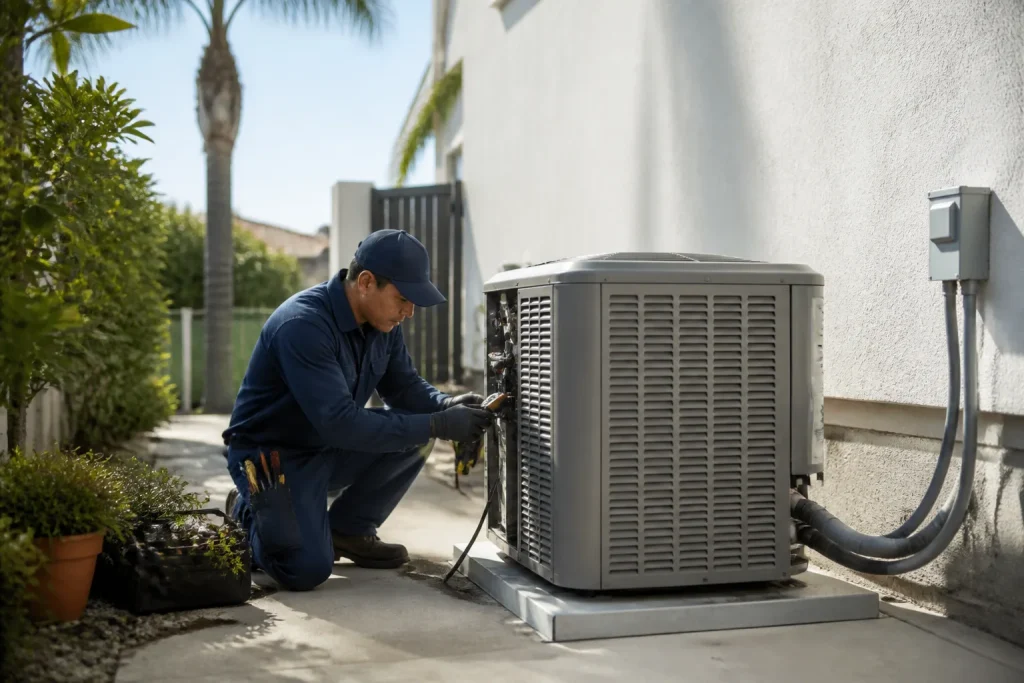
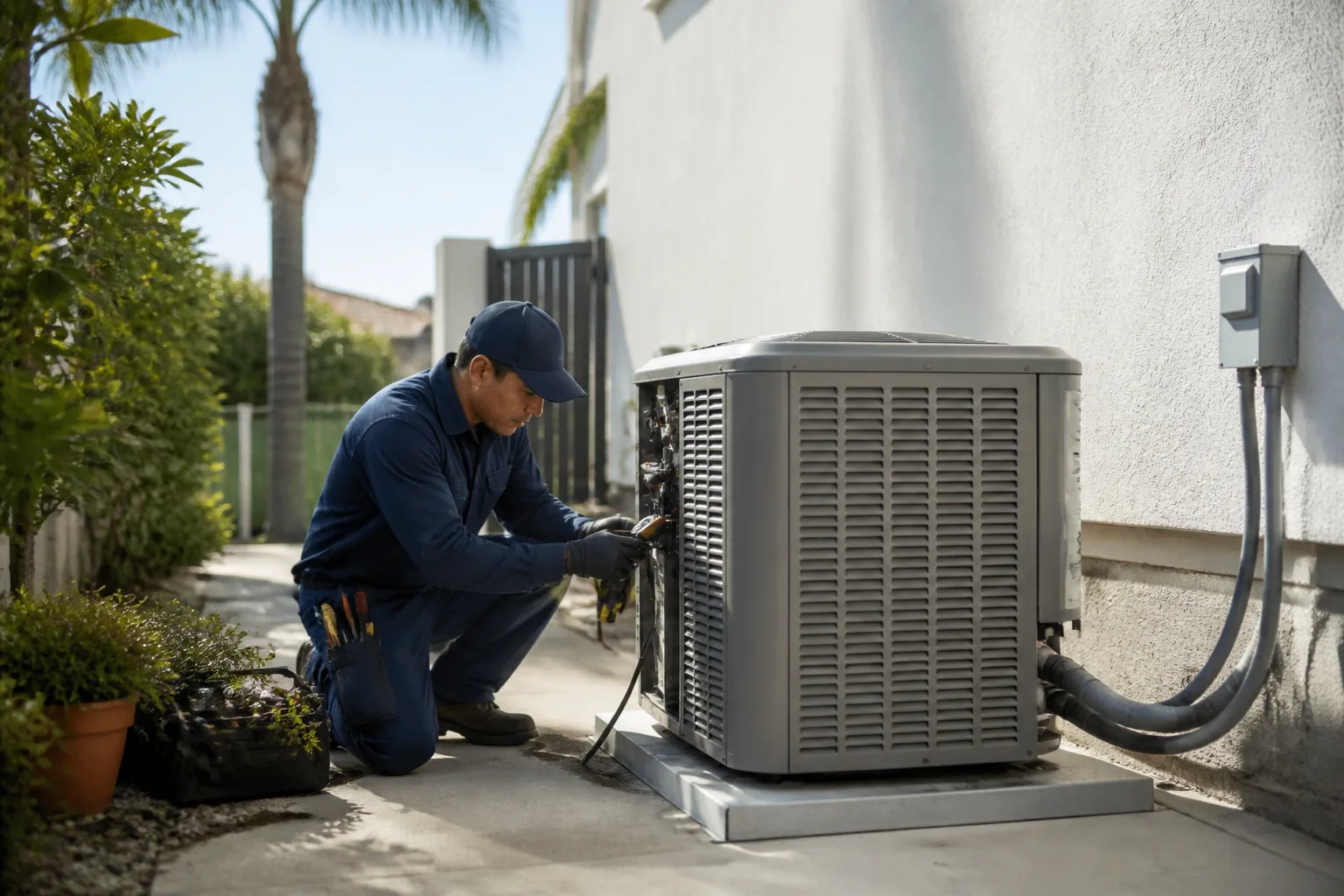
The contactor. This is the electrical switch that sends power to the compressor and condenser fan when the thermostat calls for cooling. On York units installed during the mid-2000s construction boom, many of which are now in that 15-to-18-year range, contactor pitting is routine. The symptom is predictable: you hear a chattering or buzzing from the outside condenser, or the unit hums but the fan doesn’t spin. Sometimes the contactor sticks closed, which means the outside unit runs even when the indoor system is off. That’s a symptom homeowners in Los Angeles often describe as “the AC won’t turn off even though the house is cold.” A pitted contactor is a $35 to $90 part. If you catch it early, the repair is quick and the part is almost always on a local distributor’s shelf.
The dual run capacitor. This is the cylinder that gives the compressor and fan motor their starting torque. In Los Angeles’s heat, capacitors swell and leak electrolyte. The telltale sign: the condenser fan isn’t spinning but you can hear a low hum from the unit, or the system starts but trips the breaker within a minute. Capacitors in the L.A. climate typically last 8 to 12 years. If your York system is 15 years old and has never had one replaced, it’s overdue. When a capacitor fails completely, the system won’t start at all. This is the single most common “no-cooling” call we get in neighborhoods like Sherman Oaks and Westchester between June and September.
The TXV valve. The thermostatic expansion valve, or TXV, meters refrigerant into the evaporator coil. York systems from the mid-2000s are now seeing TXV failures at a predictable rate. The symptom is less obvious than a buzzing contactor or a dead capacitor: the system runs but the cooling is weak, the coil may freeze, and your energy bill climbs because the compressor works harder than it should. A failing TXV can also cause uneven temperatures, so the living room feels okay while the bedrooms never cool down. This is a more involved repair, often $400 to $700 in Los Angeles, and the valve is sometimes a special-order part depending on the exact York model.
All three components are tied to the same root cause: age plus heat. Homes near the beach in Santa Monica don’t stress their York equipment the same way homes in the San Fernando Valley do. The ambient heat in Woodland Hills or Encino puts constant load on the capacitor and contactor in a way that a coastal breeze never will. If your York system is in that 15-to-18-year range and you’re in a hot inland neighborhood, knowing these three components is the difference between a $90 fix and a $3,000 emergency. We’ll get to the pricing breakdown in a minute.
Reading York’s LED Fault Codes Before You Call
Here’s a detail most Los Angeles homeowners don’t know, and it’s the single most useful thing in this guide: York’s air handler control board stores diagnostic LED codes for up to 24 hours after a fault. If your system tripped the breaker yesterday evening and you reset it this morning, the code is still there. You don’t need any special tools to read it. You need to know where to look and what the blinks mean.
On most York air handlers, the control board is behind the lower access panel of the indoor unit, often in a closet, garage, or attic in Los Angeles homes. There’s a small LED light. When the system runs normally, it blinks steadily. When a fault occurs, it blinks in patterns. The two you’re most likely to see on a York system in the 15-to-18-year age range:
- 3 blinks, then a pause: This indicates a high-pressure or low-pressure switch trip. In Los Angeles, the most common causes are a dirty condenser coil, restricted airflow from a clogged filter, or low refrigerant from a slow leak. A dirty coil in a dusty neighborhood like Sylmar or Granada Hills will drive the head pressure up until the switch shuts the compressor down. The unit may restart once the coil cools, which is why the problem seems to “come and go.”
- 4 blinks, then a pause: This points to a high-limit or open thermal protection fault. On many York models, 4 blinks means the compressor overloaded thermally, often because of a failing capacitor or a contactor that isn’t making clean contact. The system runs hard, overheats, and trips. This code is commonly misread by homeowners as a thermostat issue, but the thermostat isn’t the problem. The compressor is working against resistance it wasn’t designed for.
Other codes exist, but on the York equipment we service in Los Angeles, 3 and 4 blinks cover the majority of cooling failures. If you see a solid light or no light at all, check the breaker and the disconnect box near the outside unit first. If the LED is off and the breaker is on, the control board may have lost power, which is its own diagnostic clue.
Here’s the practical takeaway: write down the blink pattern before you call anyone. A homeowner who says “the air handler is blinking 3 times, pause, 3 times” has already cut 20 minutes off the diagnosis. The technician arrives, confirms the code, checks the low-voltage circuit, and moves straight to the coil or the refrigerant circuit. It saves you money and it means parts can be ordered before the technician leaves the shop, if needed.
Safety note: the control board is near line voltage. If you’re going to open the access panel to read the LED, do not touch any wiring, do not remove any connectors, and shut the system off at the thermostat first if it’s actively running. If you’re not comfortable doing this, skip it. A technician can read the stored code when they arrive. The value is in knowing the code exists, not in putting your hands somewhere they don’t belong. For anything involving the electrical supply or the condenser’s high-voltage side, call a trained AC repair professional in Los Angeles. High-voltage capacitors retain a charge even when the system is off, and that charge is dangerous.
York’s Parts Ecosystem in Los Angeles: What’s Local, What’s Not
Not all York parts are created equal in Los Angeles. Some sit on shelves at local HVAC distributors in Commerce or Van Nuys, ready for same-day pickup. Others require a special order from Johnson Controls, which has owned York since 2005, and can take three to seven business days. Knowing which category your repair falls into changes everything about your timeline.
Readily available in Los Angeles: Contactors, dual run capacitors, fan motors, contactor relays, and most control boards for York units manufactured after 2016. These are stocked at most local distributors because they’re common failures across all brands, not just York. If your technician tells you they need to “run to the supply house” for a capacitor, they’ll be back in under an hour.
Often special-order: TXV valves matched to specific York models, especially for condenser units from 2005 through 2012. Older York evaporator coils also fall into this category. The distributor in the San Gabriel Valley may have one in stock; the one in Carson may not. It’s genuinely hit-or-miss. If your repair requires a special-order TXV, expect the job to stretch across several days. A reputable company will tell you that upfront rather than discovering it after your system is already half-disassembled.
There’s a meaningful split between York equipment made before 2016 and after 2016. Units manufactured before 2016 were built under Johnson Controls but use components from the earlier design era. Parts support is still available but sometimes requires matching serial numbers precisely. Units made after 2016 benefit from Johnson Controls’ consolidated supply chain, and the most common components are broadly stocked. If you’re wondering whether your York system’s age will make a repair slower, this is the practical answer: a capacitor or contactor is almost always same-day. A TXV on a 2007 condenser is a maybe.
This is also where the company you call makes a difference. A technician who works on York equipment regularly in Los Angeles will know which distributors carry York parts in which neighborhoods, and they’ll know before they open your condenser whether the likely part is local or special-order. That knowledge is the difference between “we’ll have you cool tonight” and “we’ll have you cool next Thursday.” At Meadowsweet Heating & Air, York is one of the nine brands we service, and we keep the common failure parts on hand precisely because contactors and capacitors don’t wait for business hours.
What York Repairs Cost in Los Angeles in 2024
Let’s talk dollars. The three failures we covered earlier, the contactor, the capacitor, and the TXV, make up the vast majority of York AC repair work in Los Angeles. Here’s what a fair price range looks like for each, including the part and the labor:
- Contactor replacement: $180 to $340. The part is inexpensive, but the labor includes confirming the system is safe to work on, checking the amp draw before and after replacement, and verifying the compressor and fan motor aren’t drawing excessive current. A contactor that fails is often a symptom of a deeper electrical issue, so a thorough tech won’t just swap the part and leave.
- Dual run capacitor replacement: $200 to $380. Same story: the part is $30 to $70 at the distributor, but the labor involves testing both the compressor and fan motor, checking the capacitor’s microfarad rating against the spec on the York label, and making sure the failed capacitor didn’t take out the fan motor on its way. In Los Angeles, a capacitor replacement is usually a same-day fix.
- TXV valve replacement: $400 to $700 on most York systems, though it can climb higher on older condenser models where the part is special-order and the system needs to be recovered, evacuated, and recharged. This is not a “we’ll have it done before lunch” job. It requires refrigeration tools and a technician who knows how to set the superheat correctly on a York coil.
Those are Los Angeles market prices in 2024, not national averages. L.A. labor rates are higher than in Riverside or Bakersfield, and the cost of doing business in the city, commercial liability, permits where needed, vehicle upkeep, a live phone line, all of it shows up in the final number. If a quote comes in dramatically lower, ask what’s being skipped. If it’s dramatically higher, ask why.
Two things to know before you approve any work. First, the price should be written down before work starts, with no asterisks and no verbal caveats. We give every customer a written price before any tool comes out of the truck. Second, ask whether the repair is covered by any kind of guarantee. At Meadowsweet, the Done Right Promise backs every job we do. If it’s not done right, we make it right. No runarounds, no fine print. That matters more in Los Angeles than people realize, because a hot house with kids and pets doesn’t tolerate a second failed repair attempt.
If you’re weighing repair versus replacement on a York system that’s 15 to 18 years old, the math in Los Angeles goes like this: a $250 capacitor is a no-brainer repair. A $700 TXV on a 17-year-old condenser is a judgment call. If the system has already needed multiple repairs in the last two years, a new system quote is worth getting, and AC installation in Los Angeles comes with its own set of questions about rebates, sizing, and what the new equipment will actually cost to run. But that’s a separate decision. For now, if the capacitor buzzes and the house is warm, fix the capacitor.
The York Warranty Registration Detail Most Homeowners Miss
York changed its warranty terms over the years, and the registration deadline is where Los Angeles homeowners get tripped up. If you bought your York system from the original installer and the installer registered the equipment within 60 days of installation, you likely have the longer parts warranty, often 10 years on the compressor and key components. If it wasn’t registered, the warranty drops to the standard base term, usually 5 years on parts. That difference matters profoundly for a 15-year-old system.
Here’s the part nobody tells you: many mid-2000s York systems in Los Angeles were installed during the housing boom, and a surprising number were never registered at all. The builder dropped the unit in, the homeowner had a stack of closing paperwork, the warranty card went in a drawer or a trash can. The result is that a York system that could have had a 10-year compressor warranty actually had a 5-year warranty, and by year 7 or 8, the compressor repair was fully out of pocket.
If you’re the second or third owner of a York system, the warranty situation is even murkier. Johnson Controls’ warranty terms allow transfer in some cases but not others, and the transfer needs to be documented. If you bought a house in Los Angeles with a York unit and never checked the warranty status, you may be sitting on coverage you don’t know about, or you may be assuming coverage that isn’t there. Either way, it’s worth a phone call to York with your serial number to find out where you stand before a major component fails.
The practical advice: find your condenser’s serial number, usually on the data plate on the side of the outdoor unit, and keep a photo of it in your phone. When a repair comes up, the technician can call the distributor with that serial number and verify parts availability and warranty coverage before any money changes hands. We do this on every York repair as a standard step. It takes five minutes and occasionally saves a homeowner hundreds of dollars on a part they didn’t realize was still covered.
When to Call a Pro (and How to Prepare for the Call)
There are York repairs that a capable Los Angeles homeowner can handle, and we’ll be honest about what those are. Replacing a dirty air filter. Clearing debris away from the outdoor condenser. Checking that the thermostat batteries aren’t dead. Those are simple, safe, and worth doing before you pick up the phone.
But if the LED is blinking a fault code, if the breaker trips more than once, if the condenser buzzes without spinning, or if the system is icing up, call a professional. These are electrical and refrigerant issues. The capacitor inside an AC condenser holds a charge strong enough to stop a heart, even with the power off. Refrigerant requires an EPA 608 certification to handle legally in California. This is not a place for a YouTube tutorial.
When you call, have three things ready: the brand and approximate age of the system (York, and the year if you know it), the symptom in plain language (“outside unit hums but doesn’t spin”), and the LED blink pattern if you can safely read it. That information lets a dispatcher route the call correctly and gives the technician a head start before the truck even leaves.
At Meadowsweet Heating & Air, a live person answers every call, 24 hours a day, including weekends and nights. You won’t get a voicemail queue. We’ll ask those questions, tell you honestly if the problem sounds like a same-day fix or something that needs a part, and show up with the common York components already on hand. Our technicians are background-checked and uniformed. They wear shoe covers and put down drop cloths before any work starts indoors. Before any work starts at all, you get a written price. Those aren’t extras. They’re the baseline. We also service the other major brands you see in Los Angeles homes, from Trane and Lennox to Goodman and Rheem, so if you have mixed equipment or you’re not sure what’s in your closet, we can sort it out.
And after the repair is done, you get a photo of the clean-up before the crew leaves. We pulled a York condenser apart in a garage over in Eagle Rock last month where the homeowner had a toddler crawling around the same floor an hour before we got there. The condenser was in the garage, the capacitor had swollen, and the fix was done in 40 minutes. But the floor mattered as much as the fan motor. That’s the standard. Not because it’s good marketing, but because it’s the way the work should be done. If you’re in Los Angeles and your York system is acting up, call (747) 966-3037 for a free estimate. If it turns out your furnace needs attention while we’re there, we handle furnace repair in Los Angeles too. But let’s get the cool air back first.
The Bottom Line
York AC systems in Los Angeles fail in predictable ways. The contactor, the dual run capacitor, and the TXV valve are the three components you’ll most likely hear about, and each one shows up with a distinct set of symptoms. The LED codes on the air handler board are stored for up to 24 hours, so a system that “works fine now” still has a story to tell. Parts for common failures are usually available same-day in Los Angeles; parts for older York condensers sometimes aren’t. A fair price for the three big repairs ranges from about $180 for a contactor to $700 or more for a TXV. And the warranty on your York system depends heavily on whether the original installer registered it within 60 days of installation, which many Los Angeles homeowners from the mid-2000s never did.
If you’re in Los Angeles and need help, Meadowsweet Heating & Air offers free estimates, written pricing before any work starts, and the backing of the Done Right Promise. Call (747) 966-3037 and a real person will answer, any hour, any day.
Frequently Asked Questions
Most common York repairs in Los Angeles run between $180 and $380, covering things like contactor and capacitor replacement. A TXV valve replacement runs $400 to $700. Complex compressor or coil jobs can exceed that. We always provide a written price before any work begins, so you’ll know the exact cost before you approve anything. Call (747) 966-3037 for a free estimate on your specific system.
In most cases, yes. Contactors and capacitors are stocked locally and on hand, so a same-day fix is standard for those common failures. If your York system needs a special-order part like a matched TXV for an older condenser, the repair may take several days. We’re honest about the timeline before we start the work.
York air handlers use a diagnostic LED on the control board. Three blinks indicate a high or low pressure switch trip, often caused by a dirty condenser coil or low refrigerant. Four blinks usually signals a thermal overload or limit switch fault, often tied to a failing capacitor. The code is stored for up to 24 hours after the fault, so a technician can read it even if the system has restarted.
If the repair is a $200 capacitor or a $250 contactor, repair it. If the repair is a $700 TXV and the system has already needed multiple repairs in the last two years, start comparing replacement options. A new system in Los Angeles comes with better efficiency and a fresh warranty, and we can give you an honest assessment on AC installation without any sales pressure.
Written by the team at Meadowsweet Heating & Air.
Need HVAC Help?
Call Meadowsweet Heating & Air - licensed & insured, here with fast after-hours help in Los Angeles.
(747) 966-3037