
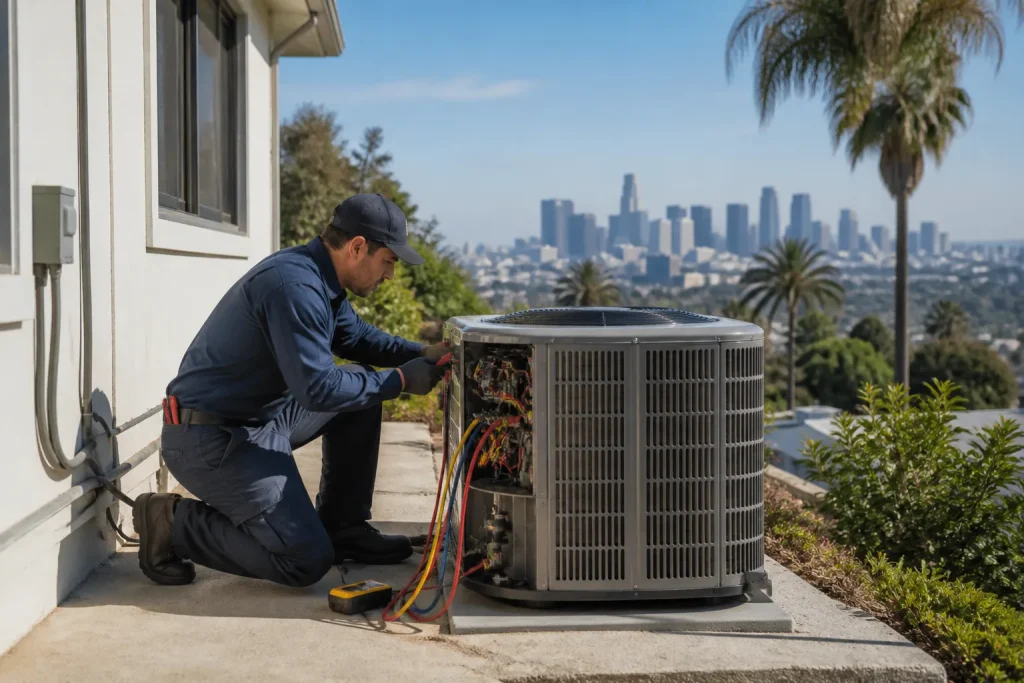
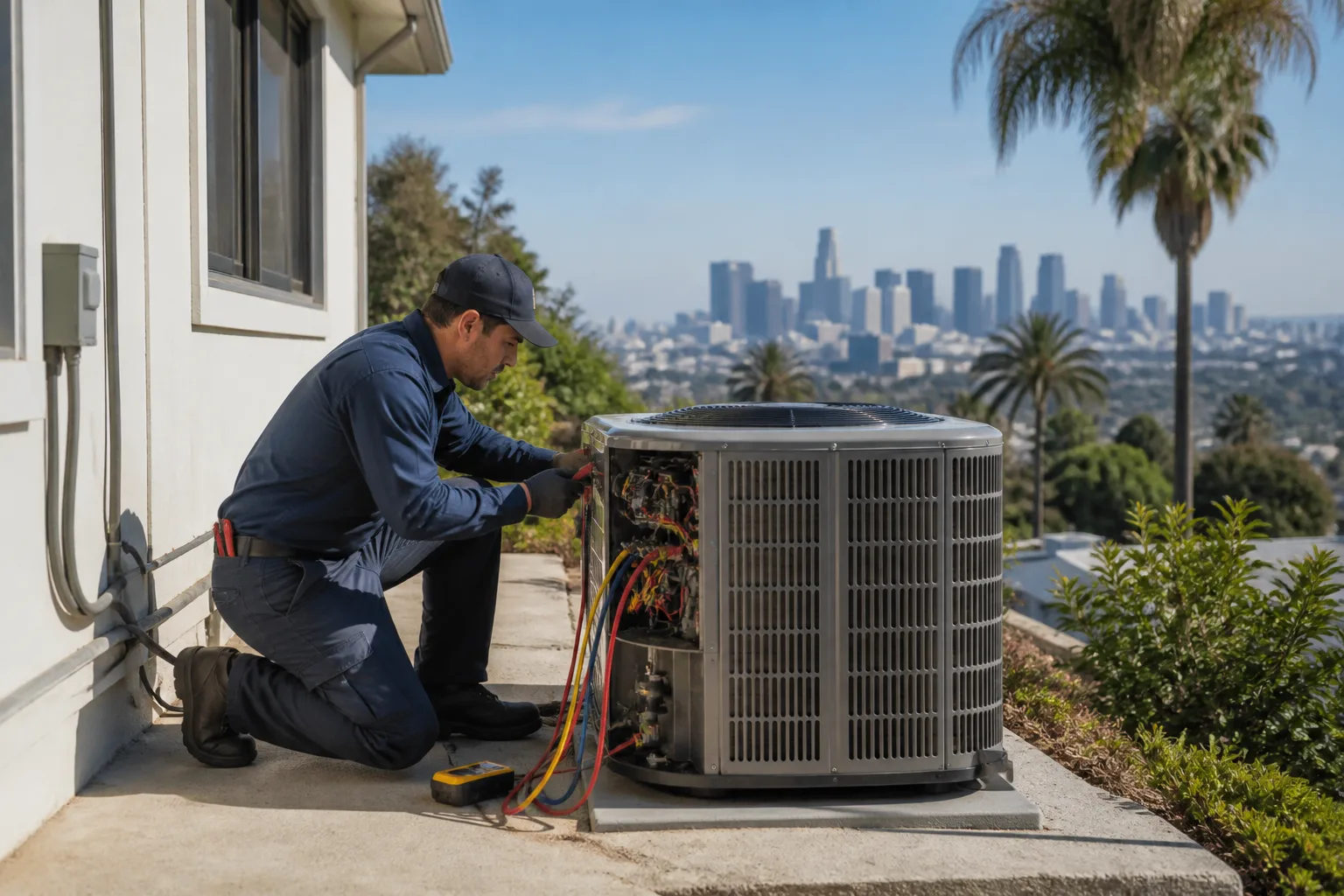
American Standard AC Repair in Los Angeles: A Homeowner’s Guide
American Standard and Trane share the same parent company and many identical internal components, yet repair quotes for the same failure can differ by $200 depending on which badge sits on the unit. In Los Angeles, where a downed AC in August is a genuine health issue, that gap matters. This guide explains why the two brands overlap, what actually fails on American Standard units in LA’s climate, and how to spot a repair quote that’s padded with confusion you shouldn’t be paying for.
If you’d rather skip the details and just get a straight answer about your system, call Meadowsweet Heating & Air at (747) 966-3037. We’ll give you a written price before any work starts and tell you honestly whether the repair is worth making.
Why American Standard and Trane Confuse LA Homeowners
American Standard and Trane are siblings under the same corporate roof, built on shared platforms, with many components stamped from the same molds. A condenser fan motor on a Trane XR14 is often the identical part as the one on an American Standard Silver 14, right down to the part number. Compressors, contactors, capacitors, and control boards frequently cross over. So when an LA homeowner gets two quotes, one from a technician who calls the unit a Trane and one who calls it an American Standard, the difference isn’t always about skill. Sometimes it’s about which parts catalog the technician pulls from, and whether that catalog has a markup baked in.
Here’s the practical reality in Los Angeles: some independent shops and distributors stock Trane parts but not American Standard equivalents, because Trane has deeper commercial roots in Southern California. That can mean a longer wait for a “correct” American Standard part number when a same-day Trane part would bolt right on and perform identically. A careful technician checks interchangeability before ordering. A careless one orders whatever the catalog says and passes the courier fee down the invoice. Before you approve any repair, ask: is the part you’re ordering interchangeable with the Trane equivalent, and if so, which one arrives faster? That single question has saved LA homeowners hundreds of dollars on repair timelines alone.
- Identical across both brands: most capacitors, contactors, condenser fan motors, and compressor families
- Different across brands: some control board logic, thermostat communication protocols on higher-SEER models, and cosmetic panels
- What this means for you: a good technician checks cross-reference charts before quoting. A lazy one doesn’t.
We’ve worked on American Standard systems in neighborhoods from Sherman Oaks to South Gate, and we keep the interchange guide on our tablets. It’s not a flex. It’s just what prevents you from waiting four days for a part that’s sitting on a shelf under a different name.
What Actually Fails on American Standard Units in Los Angeles
LA’s dry-season heat puts a specific strain on American Standard condensers. The city routinely sees stretches of 90-plus days where the unit runs six to eight hours daily, cycling on and off against the thermostat. That pattern, month after month from June through October, wears down two components faster than any other: capacitors and contactors. Capacitors store the voltage needed to start the compressor and fan motor. Contactors are the electrical switches that close the circuit when the thermostat calls for cooling. Both sit in the condenser cabinet, where afternoon sun bakes them through the metal shroud.
We replace more blown capacitors and pitted contactors on American Standard units than any other brand in our Los Angeles service area, not because the brand is weak, but because those parts are the first to fatigue when the cooling season runs long. Homeowners often notice the signs without knowing the names: the outside unit hums but the fan doesn’t spin, or cooling is weak and inconsistent, or the system trips its breaker on a hot afternoon. None of those symptoms mean the compressor is dead. They usually mean a capacitor has lost its capacity or a contactor’s contacts are charred. Replacing both, with parts in hand, is a one-visit repair that should land in the $220 to $380 range including service and install, depending on the part specs and your neighborhood’s hourly rates.
What Los Angeles homeowners should not accept is a technician who arrives, sees a bad capacitor, and starts talking about a full system replacement. That’s not diagnosis. That’s sales pressure. A capacitor doesn’t kill a compressor unless the system is run for weeks with the fan motor not spinning. If you catch it within a few days of the first symptom, the repair is small and the system is fine.
The AccuClean Misdiagnosis You Should Know About
American Standard offers an integrated air filtration system called AccuClean, and it has a failure mode we see misdiagnosed more often in LA than almost any other brand-specific issue. AccuClean is an electrostatic filter that captures particles down to 0.1 microns and is installed in the air handler or duct plenum. When its power pack or cells begin to fail, the system can produce a slight electrical odor, a faint crackling sound, or a sudden drop in airflow across the evaporator coil. Those symptoms, on the surface, look like refrigerant issues, a failing blower motor, or even a compressor that’s struggling against high head pressure.
Here’s what happens in practice: a technician arrives, measures pressures, finds the system slightly off from expected numbers, and assumes the charge needs adjustment or the compressor is tired. They may add refrigerant. They may quote an evaporator coil replacement. What they don’t do is pull the AccuClean power supply and test it, or check whether the filter cells are arcing. When that happens, you pay for a repair that doesn’t fix the airflow restriction and the real problem persists.
The tell: if your American Standard system has an AccuClean unit and you notice a new smell, a new noise, or reduced airflow from the vents, mention the AccuClean by name to the technician before they break out the gauges. Ask them to test the filtration system’s power draw. A failing AccuClean power supply typically pulls little to no current, while an arcing cell will show intermittent draw. Testing takes five minutes. It can save you from a $700 misdiagnosis. In our experience on the Westside and in the Valley, the fix is usually replacing the power pack or the filter cells, not the mechanical cooling components.
Warranty Claims on American Standard Systems: What LA Homeowners Miss
American Standard systems carry a solid factory warranty, but there’s a registration step many Los Angeles homeowners skip without realizing the cost. When the system is installed, equipment must be registered within 60 days (or a limited window set by the manufacturer) to receive the full extended parts warranty. Unregistered units drop to a shorter base warranty, often five years instead of ten, depending on the model and year. Installers sometimes register the system for the customer. Sometimes they don’t. If you never confirmed it, you may be sitting on a valid claim you can’t actually file.
Before you approve any repair on an American Standard system that’s under ten years old, check the registration. You can call American Standard’s warranty line with your serial number and confirm what’s covered. A parts warranty may cover a failed compressor or control board, even when the labor to install it is not included. That’s a meaningful offset in Los Angeles, where a compressor replacement with labor can run from $2,400 to $3,800 depending on tonnage and access.
We tell every American Standard owner we visit to keep the serial number somewhere easy to find, like a photo on a phone. The serial is also printed on a label inside the condenser cabinet and on the air handler. When a technician knows the serial before ordering parts, warranty eligibility can be checked before a quote is even written. That’s the responsible order of operations. Any shop that skips the warranty check and quotes full retail is either rushed or banking on you not knowing better.
What a Responsible American Standard Repair Visit Looks Like
If you’ve never had AC repair done in Los Angeles before, it helps to know what a proper visit includes before the work starts. The benchmark isn’t a flashy van or a quick diagnosis. It’s whether the technician does the job in a way you’d accept in your own home. Here’s the sequence we hold ourselves to on every American Standard repair:
- The technician arrives in uniform, introduces himself by name, and walks the property with you to confirm where the equipment is before touching anything. He doesn’t wander into the backyard without your knowledge.
- Diagnosis happens, then the written price. No work begins until you’ve seen the price in writing. That price includes parts, labor, and any service call charges, itemized so you can see what you’re paying for. No verbal estimates. No “we’ll see once we get into it” without a firm ceiling.
- Floor protection goes down before tools come out. Shoe covers at the door, drop cloths under the work area, and a path back to the unit. If the air handler is in a closet or garage, the same standard applies. The space should look no different when the crew leaves than when they arrived.
- Before the technician departs, he shows you a photo of the cleaned-up work area and walks you through what was replaced, why it failed, and how to avoid a repeat. You should understand the invoice before you pay it.
These aren’t extras. They’re the baseline anyone should expect for AC repair in Los Angeles, and they’re precisely what the Cedarwell Care Promise standardizes across every visit.
When to Repair vs. Replace an American Standard System in Los Angeles
The repair-or-replace decision on an American Standard system comes down to three numbers: the system’s age, the cost of the repair, and the refrigerant involved. Systems in LA that run hard through long summers often begin to show real wear at the 12-to-15-year mark. Before that, a single component failure, even a compressor, is often worth repairing if the rest of the system is sound. After 15 years, you’re weighing each repair against the cost of a new high-efficiency system that will cut your summer power bills.
The refrigerant question is blunt. If your American Standard system uses R-22, the old refrigerant that’s been phased out, repair costs climb quickly because the refrigerant itself is expensive on the remaining market. At that point, many LA homeowners choose to replace rather than sink $800 into a system that will need another repair next season. A system built for R-410A is usually worth repairing through its normal lifespan. During a visit, we’ll tell you honestly which path makes sense, and if replacement is the right call, we walk you through AC Installation in Los Angeles with the same written-price standard.
You can find the refrigerant type on the unit’s data plate, usually printed with the serial number. R-410A is the modern standard. R-22 means the system is old enough that every repair decision includes a larger conversation.
What to Ask Before Any Repair
If you’re standing in your driveway with a technician and you want to protect yourself, ask these four questions before approving anything:
- Is the replacement part interchangeable with the American Standard or Trane equivalent, and which one can you get faster? This alone fends off markup on a part number difference.
- Is my system’s warranty active, and have you checked the serial number? If they haven’t checked, wait until they do.
- Will you show me the failed part and explain what it does? A technician who can’t or won’t explain the diagnosis is not someone you want inside the unit.
- What will the work area look like when you leave? The answer should include floor protection, cleanup, and a walkthrough. If it doesn’t, ask again.
Los Angeles has no shortage of HVAC companies, and the gap between the good ones and the rushed ones often shows up in these four questions. We answer all of them on every visit, because the Cedarwell Care Promise isn’t a line on a brochure. It’s the system we built our service around: a written price before work, a clean floor, and a technician who treats your home like a home.
When to Call a Pro
American Standard systems are sturdy, but the electrical components inside them aren’t something to troubleshoot with a multimeter from the hardware store unless you know exactly what you’re doing. Capacitors hold a charge even after the power is off, and a wrong wire on a contactor can short a control board. If your system is blowing warm air, making a hum from the outside unit, or tripping a breaker, that’s the moment to call a professional. The good news is that these are often small, fast repairs in the right hands. For broader context on how we handle these calls across the city, see our AC Repair in Los Angeles service page.
Related services in Los Angeles: if your system needs more than a component fix, we also handle Furnace Repair in Los Angeles and full system installation, with the same standards on every call.
The Bottom Line
American Standard AC repair in Los Angeles doesn’t have to be confusing, but it often is, because the brand’s shared DNA with Trane opens a door for sloppy quotes and misdiagnosed AccuClean issues. Learn what’s interchangeable, check your warranty before work starts, and insist on a written price. Those three habits will save you money and keep a small repair from turning into a big one.
If you’re in Los Angeles and need help with an American Standard system, Meadowsweet Heating & Air offers free estimates. We’re part of the Cedarwell family of HVAC companies, built around the Cedarwell Care Promise, and every visit includes a written price, shoe covers and drop cloths, and a photo of the clean-up before we leave. Call (747) 966-3037 and talk to a live person, 24 hours a day, even on weekends. No voicemail queue.
You can also start at our Meadowsweet Heating & Air home page to learn more about how we work across the city.
Frequently Asked Questions
Most common repairs, like capacitors and contactors, run between $220 and $380 including the service call. Compressors and control boards cost more, typically $2,400 to $3,800 depending on the system size and warranty coverage. The best way to get an exact number is to have a technician check your serial number and test the system, then put the price in writing before work begins. Call (747) 966-3037 for a free estimate.
Many are, especially capacitors, contactors, condenser fan motors, and compressors. The units share a parent company and many platforms. This means a technician who knows interchange charts can often find a same-day part under the Trane catalog that fits your American Standard unit perfectly. Ask your technician whether the part crosses over before they quote you a long wait.
If your system is under 12 years old and uses R-410A refrigerant, repair is usually the right call. If it’s over 15 years old and uses R-22, replacement often makes more financial sense, because R-22 refrigerant is increasingly expensive and the system is already past its typical service life. A good technician will show you the numbers on both paths before you decide.
Find the serial number on the data plate inside the condenser cabinet and call American Standard’s warranty line. Ask whether the equipment was registered within the required window after installation, which affects whether you have the full extended parts warranty or the shorter base term. A repair company should check this for you before quoting parts. If they don’t mention it, bring it up yourself.
Written by the team at Meadowsweet Heating & Air.
Need HVAC Help?
Call Meadowsweet Heating & Air - licensed & insured, here with fast after-hours help in Los Angeles.
(747) 966-3037