
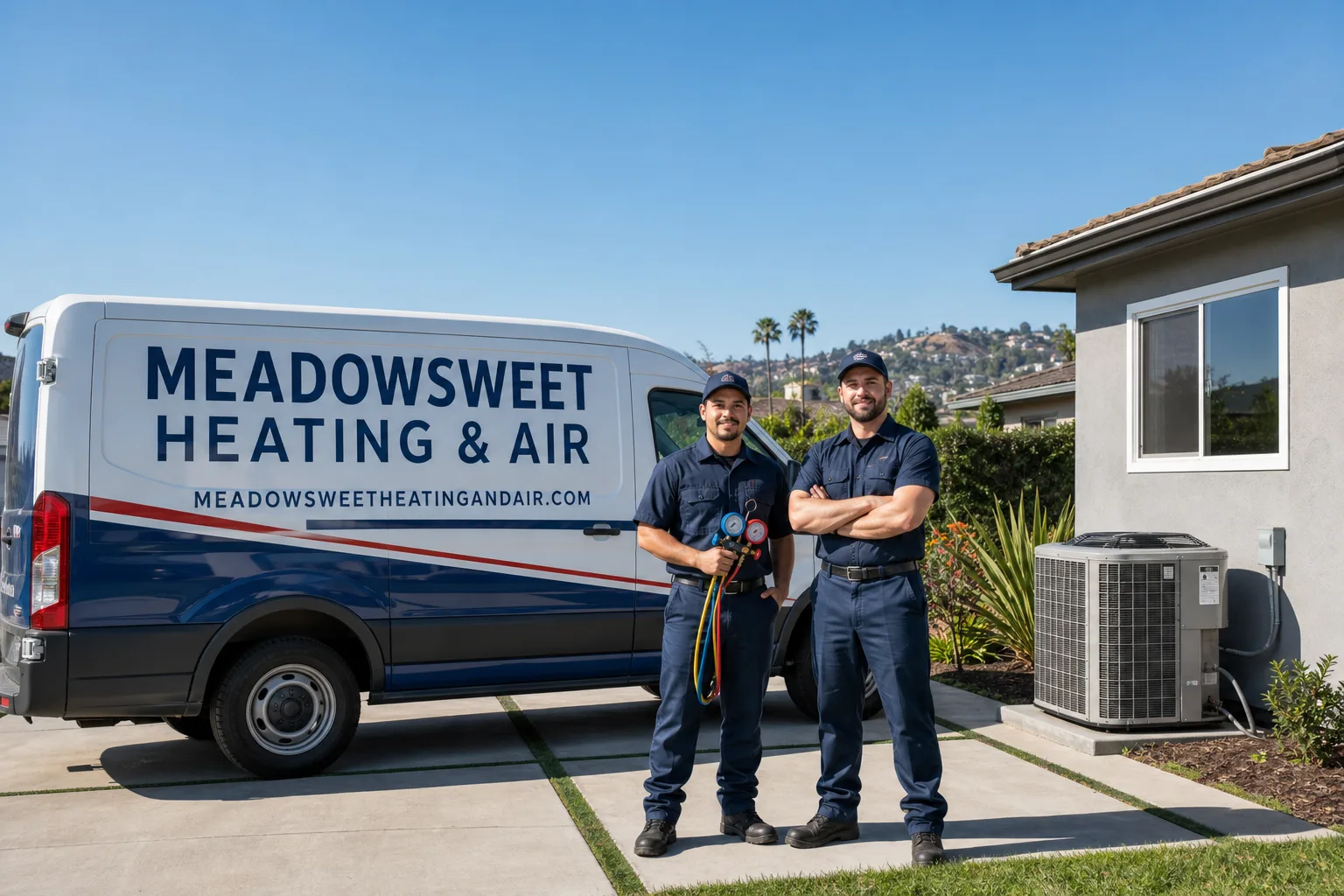
Seasonal tune-up and full diagnostic on your Carrier, Trane, or Goodman system - readings shown to you before any repair is proposed
Diagnosis first, numbers second - you approve the repair price before a single part goes in.







 Before
 After
After Before
 After
After Before
 After
AfterFast, Reliable AC Repair Across Stanford
When your air conditioner quits on a 94°F afternoon in Stanford, you need a repair crew that understands the specific quirks of university-owned housing stock, not a generic contractor who has never dealt with Stanford Facilities Management approvals. We get calls from faculty and staff homes off Mayfield Avenue, Frenchman’s Road, and the Escondido Village area every summer, and we know that a no-cool call here often involves older equipment, aging ductwork, and a landlord-side electrification timeline that complicates even a simple capacitor swap. Most AC repairs in Stanford run between $150 and $650, and we can usually have a technician at your door the same day you call. Reach us at (747) 966-3037 for a free estimate and a written price before any work starts.
Why Meadowsweet Heating & Air Is Stanford’s Preferred AC Repair Company
Stanford homeowners deal with something no other Peninsula city faces: a single institutional landlord that owns virtually all residential land and must approve HVAC changes before work can proceed. Our team knows how to prepare documentation, flag electrification requirements, and coordinate with Stanford Facilities Management so repairs do not stall in approval limbo. Luis Serrano, who leads our crews, has walked more Stanford faculty-housing enclaves than he can count, and he trains every technician on the C.A.R.E. values that matter here: clean up like it is their own home, ask before moving anything, respect quiet hours, and explain the price before touching a single component.
Every visit includes shoe covers and drop cloths inside your home, plus a photo of the clean-up sent before the crew leaves. That matters when you have kids crawling across the floor and pets who investigate strangers. We also answer every call with a live person, 24 hours a day, seven days a week. No voicemail queue at 2 a.m. when a Diablo wind surge just killed your compressor. And every job carries the 365-Day Done Right Promise: if it is not done right, we make it right, no runarounds and no fine print.
AC Capacitor Replacement in Stanford
AC Capacitor Replacement in Stanford is one of the most common repairs we perform in the university’s older ranch homes, where original systems from the 1960s and 1970s are still pushing air through undersized ductwork on 8-to-12-year-old compressors. The capacitor is the small cylindrical component that gives the compressor and fan motor the electrical jolt they need to start. On a Stanford summer afternoon when temperatures spike into the low 90s, a weak capacitor may let the system run but not start reliably, or start but draw excessive amperage that trips the breaker. A capacitor replacement typically falls within the $150-$650 range on Stanford properties, depending on whether we are also addressing a refrigerant charge issue or a dirty condenser coil during the same visit.
When a Capacitor Fails in an Older Stanford Home
The Diablo wind season hits Stanford in early fall, just as cooling demand should be winding down. Those sudden hot, dry surges push aging capacitors past their limits, and we regularly see failures in September and October that homeowners assume are compressor problems. If your system hums but will not start, or starts only intermittently, call us before the compressor sustains damage from repeated failed starts. A five-minute capacitor test tells us whether the part is merely weak or fully out of tolerance.
Why Ductwork and Static Pressure Matter Here
Replacing a capacitor on a system with severely undersized ductwork is a temporary fix if we ignore what caused the strain in the first place. In Stanford’s 1940s ranch homes, original ducts were sized for heat only, never for mechanical cooling. High static pressure starves the evaporator coil, which freezes, which then stresses the compressor and its capacitor. Any repair we perform includes a static pressure reading so we can tell you honestly whether a like-for-like fix will hold or whether the ductwork needs to be on the university’s electrification review list.
AC Recharge in Stanford
AC Recharge in Stanford homes often follows a familiar pattern: a system that has never had its refrigerant level checked, running through ducts that were never meant for cooling, slowly losing charge through a pinhole or a worn Schrader valve. Our AC Repair team performs recharges on Carrier, Trane, Goodman, and Rheem systems across the Stanford campus periphery, and the work typically runs $150-$650 depending on whether we need to recover old refrigerant, find and seal a leak, and how much R-410A or R-22 your system requires. A recharge is not a casual top-off. We measure subcooling and superheat to confirm the charge is correct for your specific system, not just “close enough.”
Signs a Stanford Home Needs a Recharge
Warm air from the vents even when the thermostat is set to 72°F, a coil that ices over on a day when the house never used to need cooling, or longer run times on rooms that used to cool quickly. These symptoms show up repeatedly in the faculty-housing enclaves off Mayfield Avenue, where original 1960s ductwork forces systems to work harder than they ever did when they were first installed. The home may have gone decades without air conditioning, so the first few summers of mechanical cooling expose every weakness at once.
Why We Recover Before We Recharge
Stanford’s carbon-neutrality plan means refrigerant handling is not optional carelessness. We recover old refrigerant rather than venting it, we do not “top off” a system with a known leak, and we document the charge weights so your landlord or Stanford Facilities Management has a clear record of what was done. That documentation matters when the university is deciding whether to repair or replace equipment on a ground lease.
Trusted Brands We Service in Stanford
Meadowsweet Heating & Air is qualified to service equipment from nine major manufacturers, including Trane, Lennox, Goodman, and Rheem systems that are common across Stanford’s rental housing stock. Because we carry a broad selection of capacitors, contactors, fan motors, and thermostats in our service vehicles, a Stanford call rarely requires a second trip to a supply house. That is a real advantage when you are waiting in a house at the base of the Santa Cruz Mountain foothills and the afternoon heat is climbing. We service whatever brand is already on your pad, and we do not push a replacement when a precise repair will hold.
Common AC Repair Problems We See in Stanford Homes
- Frozen evaporator coils on older ranch houses. Original 1940s-to-1970s ducts were sized for heating only, so when a first-time cooling system is added, static pressure climbs and the coil freezes. The AC runs constantly but the house never actually reaches the thermostat set point on a 94°F afternoon. We see this on nearly every first-time cooling job in Stanford’s peripheral faculty housing.
- Single-zone imbalance across split levels and hallways. A thermostat in one hallway satisfies while a back bedroom stays 8 to 10 degrees warmer. The compressor short-cycles, runs too often, and fails earlier than it should. This is a floor-plan problem as much as an equipment problem, and it requires a repair approach that accounts for airflow, not just refrigerant.
- Diablo wind heat surges killing compressors in September and October. The cooling season should be over, but a sudden hot, dry blast pushes an 8-to-12-year-old compressor past its limit. Weak capacitors and low refrigerant charges become full failures right when the landlord has not yet approved a heat-pump replacement.
- Electrical panels that are too low-amp for a modern system. Many of Stanford’s older ranch homes still carry 100-amp panels that were fine for a gas furnace and a dryer but cannot support a heat pump, an EV charger, and a modern AC condenser simultaneously. Any repair or upgrade plan here has to include the panel conversation, or the new equipment will trip breakers from day one.
Pricing for AC Repair in Stanford, CA
We give you a written price before any work starts, every time. Here are the ranges you can expect in Stanford, based on the homes and systems we actually see here.
| Service | Typical Stanford Price Range |
|---|---|
| AC Repair (diagnostic + repair) | $150-$650 |
| AC Capacitor Replacement | $150-$650 |
| AC Recharge | $150-$650 |
What moves a capacitor replacement toward the top of that range is usually a simultaneous refrigerant charge correction, a dirty condenser coil that needs cleaning, or a blower motor that also needs attention. What moves a recharge toward the top is leak detection, recovery of old refrigerant, and a partial wire or contactor replacement. We do not hand you a vague estimate and settle up later. We tell you the number, you approve it, and the number does not change. Estimates are free, and a live person answers at (747) 966-3037.
We Also Serve Cities Near Stanford
While this page is written for Stanford residents, our AC Repair in Stanford crews also serve the surrounding Peninsula communities. We regularly take calls from Palo Alto, Menlo Park, Atherton, and Los Altos. If you live just across the line, the same written-price guarantee, shoe covers, and 365-Day Done Right Promise apply. Call the same number, (747) 966-3037, and we will route a technician to you.
Serving Stanford, CA - Our Local Coverage Area
We’re based in the Stanford area and know this community well. Use the map below to see our service coverage - if you’re nearby, we can almost certainly help.
FAQs About AC Repair in Stanford
No. Because Stanford owns nearly all residential land and operates under a carbon-neutrality plan that bars new gas appliances, a failed AC in a university-owned home almost always triggers a Stanford Facilities Management review, and that review typically requires a heat-pump conversion rather than a like-for-like condensing unit swap. Your landlord, not you, will make the replacement call, and our job is to provide the repair documentation and equipment assessment that supports that decision. Call (747) 966-3037 and we will prepare the report Stanford needs.
You should know that the original ductwork in most 1940s-1970s Stanford ranch homes was sized for heating only, not mechanical cooling. Adding a condenser and coil without evaluating static pressure almost always results in a frozen coil, short-cycling, and a house that still does not cool on a 94°F afternoon. You will also need to confirm your electrical panel can handle the new load. We can assess all of that before any equipment is ordered, and we can give you a written price for the full scope.
It is worth a call today. A weak capacitor makes the compressor work harder on every start, draws more amperage, and shortens the life of a component that costs far more to replace than a capacitor does. On a Stanford Diablo wind day, a capacitor that was merely weak in August becomes a fully failed start in September. Ignoring it now usually means a more expensive compressor repair later. We can test it in five minutes and install a new one for $150-$650 the same visit.
Your house is telling you that the ductwork was never engineered for air conditioning. Stanford’s older ranch homes ran on heat alone for decades, relying on the natural cooling from the foothill nights. When mechanical cooling is added, the undersized ducts restrict airflow, the evaporator coil freezes, and the system cannot satisfy the thermostat. The fix is rarely just “add refrigerant” or “replace the coil.” It is an airflow correction, and we can measure and explain exactly what your ducts are doing before any repair is made.
No, but the scope of what you can hire us for is different depending on where you live. The central campus buildings served by the Stanford Energy System Innovations heat-recovery loop are not our market. But the peripheral faculty and staff housing enclaves, the ranch homes on university ground leases, those are residential systems we service routinely. The university’s electrification timeline applies to those homes, and we are familiar with the paperwork and the equipment requirements it creates. Call (747) 966-3037 and we will tell you exactly what applies to your address.
Written by Luis Serrano, Owner at Meadowsweet Heating & Air, serving Stanford, CA. Part of the Cedarwell family of HVAC companies, founded in 2004.