
Daikin AC Repair in Los Angeles: A Homeowner’s Guide
Most Daikin service calls in Los Angeles start the same way: the indoor unit is blinking a code, and nobody in the house knows what it means. That blinking light is actually Daikin’s strongest feature. It’s an error code system that often points directly to the failing component, saving you hours of guesswork and a diagnostic fee that another company might spend re-learning what your unit already knows. The trick is reading it before you call, because the code can tell you whether you need a $30 filter cleaning or a $600 inverter board repair. If you’d rather skip the detective work, call (747) 966-3037 and we’ll read it with you over the phone.
- Key Takeaways
- Daikin error codes display on the remote or indoor unit and often identify the exact failing part.
- Mini-split and VRV systems fail differently than ducted units and need inverter-trained technicians.
- Los Angeles coastal air and inland heat create specific failure patterns: coil fouling, drain issues, PCB sensitivity.
- Daikin’s OEM-only parts policy means repair timelines depend on a local distribution network, which exists in Southern California.
- The 12-year warranty is common but often voided by skipped registration steps.
How to Read a Daikin Error Code in Los Angeles (Before You Call)
Daikin gives you more diagnostic information through its error code system than almost any other brand we service. When something fails, the indoor unit either flashes a code on its display panel or the remote controller’s screen shows a letter followed by numbers or symbols. Most Daikin remotes use a small button labeled something like “Cancel” or “Timer Cancel” held down for 5 to 10 seconds to cycle through stored error history. The code that appears most recently is your current fault.
Here are the codes we see most often on Daikin systems in Los Angeles homes, in plain language:
- A1 or A5 – Indoor coil or control board fault. Usually a dirty coil, a failing sensor, or, in older units, a board that has corroded from coastal humidity. In Westchester and Playa del Rey we see this more than anywhere else in the city.
- E5 or E6 – Compressor or outdoor unit communication fault. This can mean a failed inverter board, a wiring issue at the condensing unit, or a voltage problem at the disconnect switch.
- F3 – High discharge temperature. In Los Angeles this frequently appears on 100-degree days in the Valley when the outdoor coil has never been cleaned and the system is working against itself.
- U2 or U4 – Power supply fault or undervoltage. We’ve found this on homes near DWP infrastructure work in Echo Park and Silver Lake where grid fluctuations trip the system’s self-protection.
- C4 or C9 – Heat exchanger or thermistor sensor fault. Common on older Daikin units where the sensor wires have become brittle from attic heat.
If the code is flashing at you, write it down along with anything unusual happening: chirping sounds, reduced airflow, warm air, water dripping inside the home. That combination is often enough for a trained eye to know the repair before arriving. And if the remote won’t display anything at all, check the batteries first. We’ve driven out to more than a few Los Angeles homes where the only problem was dead AAA batteries in the wireless controller.
Why Inverter Training Matters for Daikin Repair in Los Angeles
The single biggest mistake homeowners make when hiring for Daikin AC repair in Los Angeles is assuming any HVAC tech can work on it. Daikin’s current lineup is built around inverter compressors and variable refrigerant flow. A conventional AC unit is binary: the compressor is either at full speed or off. A Daikin mini-split or VRV system varies compressor speed constantly, sometimes hundreds of times per hour, based on the load in each zone.
That means diagnosis is different. A tech who tests an inverter system the way they test a single-stage Goodman or Rheem unit will often misread voltage fluctuations as a bad board when the real issue is a refrigerant charge that’s 4 ounces low, or a failing EEV (electronic expansion valve) that’s opening and closing at the wrong intervals. We’ve watched it happen: a homeowner in Los Feliz paid $800 for a board replacement from a company that never tested the compressor windings, and the unit failed again in three weeks.
When you call any company for Daikin repair in Los Angeles, ask these questions before booking:
- “Do your technicians carry Daikin-specific training for inverter diagnostics?” A real answer sounds like yes, with details. A vague one sounds like “we work on all brands.”
- “Do you use the Daikin service checker or laptop interface for board-level diagnosis?” If they don’t know what that is, find someone else.
- “Do you stock the Daikin service manual for my specific model?” Again, specifics matter.
We service nine major brands, including Daikin, Bryant, and American Standard, but we treat each manufacturer’s platform differently. A Daikin is not a Carrier with a different emblem. The inverter architecture is a different animal.
How Daikin Systems Fail in Los Angeles (and What It Costs)
Every city has a signature failure profile for HVAC equipment, and Los Angeles is actually three different profiles layered on top of each other. If you live in Santa Monica, Venice, or Marina del Rey, your Daikin outdoor coil is getting coated with salt-laden marine air. That film insulates the coil, raises head pressure, and shortens compressor life. We recommend annual coil washing within 3 miles of the coast, and we’re more aggressive about it on inverter systems because their coils run at higher heat densities.
If you’re inland, in Woodland Hills, Tarzana, or Studio City, your failure pattern is heat-related. Contactor and capacitor wear accelerates, the thermal paste on the inverter board’s heat sink dries out, and sometimes the board’s solder joints crack from repeated thermal expansion. That’s a real failure mode, not a scare tactic. We’ve pulled boards out of Valley units where you can see the hairline fractures under a magnifier.
And in every neighborhood within the marine layer band, from Culver City up through the Cahuenga Pass, high-humidity mornings and evenings create drain pan and condensate pump problems. Daikin’s low-profile ducted units especially benefit from regular drain line maintenance, because their pans are shallow and their float switches are sensitive. A clogged drain line with a Daikin almost always shuts the system down, which is actually a good thing. It’s protecting your drywall and your floors from a slow leak.
Here’s the price reality for Daikin repair in Los Angeles based on what we’ve seen in the field:
| Repair Type | Typical Cost in Los Angeles | Time to Complete |
|---|---|---|
| Diagnostic service call | $89-$149 | 1-2 hours |
| Thermistor or sensor replacement | $180-$320 | Same day |
| Drain line clearing and pan cleaning | $150-$280 | Same day |
| Inverter board replacement (parts and labor) | $500-$1,100 | 2-5 days if part is in stock |
| Compressor replacement on a VRV system | $2,200-$4,500 | 5-10 days, depending on crane access |
| Full outdoor unit replacement (mini-split) | $3,800-$6,500 installed | Scheduled, not same-day |
Your price depends on model, location of the unit, and whether the part is on a shelf in a Los Angeles warehouse or has to come from Daikin’s national distribution center. Which brings us to the next section.
Daikin Parts in Southern California: What’s Actually Available
Daikin runs a strict OEM-only parts policy. Unlike some other brands we service, including Goodman and Rheem, there is almost no legitimate aftermarket for Daikin control boards, inverter drives, or fan motors. That’s not necessarily a bad thing. Authentic parts mean the repair holds up. But it does mean repair timelines depend on parts availability, and that availability is different in Los Angeles than it is in, say, Phoenix.
Southern California is home to several major Daikin distribution hubs, mostly clustered in the Inland Empire and northern Orange County. For common failure items like thermistors, drain pumps, fan blades, and run capacitors, the turnaround is usually same-day or next-day. For rarer parts, like a specific revision of a VRV III outdoor board or an older ducted air handler control, the timeline can stretch to a week or more while the part comes from Daikin’s national warehouse in Texas.
The takeaway: before any repair company gives you a completion date, they should be checking actual parts availability for your exact model. If the answer is “we’ll let you know when it gets here,” you’re being handled. We check parts stock before we leave your driveway, and we write the expected delivery window into your quote.
We serviced a Daikin VRV system in Highland Park last month where the previous company had guaranteed a two-day repair. The part was backordered nationally for nine days. The company didn’t know because they never checked the DAIP portal. The homeowner lost two more days of comfort in a July heat wave because of bad information, not a bad system.
Daikin’s 12-Year Warranty: What Los Angeles Homeowners Miss
Daikin’s 12-year registered warranty is one of the better manufacturer warranties in this market. With the right registration and regular maintenance, you’re covered on the compressor and most major components for a little over a decade. But there’s a catch, and it’s a big one in Los Angeles.
Many Daikin warranties require online registration within 60 days of installation. Not 90 days, not “whenever you get around to it.” Sixty days. And here’s the part that stings: we regularly meet Los Angeles homeowners who never registered at all, because the installer said they’d handle it and never did. The warranty still exists through the unregistered term, but it’s often reduced in length and sometimes parts-only where registered coverage would include labor allowances.
What the warranty covers:
- Compressor failure due to manufacturer defect on registered units, often 12 years
- Parts failure on registered units, often 12 years
- Indoor and outdoor coils on registered units, often 12 years
What it does not cover:
- Labor, unless you have a separate labor warranty from the installing company
- Damage from power surges, unless a surge protector was installed at the disconnect
- Coil corrosion from coastal salt air, which is excluded in many Daikin warranty terms
- Failure due to lack of maintenance, including clogged drains and dirty coils
- Failure caused by installation errors, which is why installer reputation matters as much as brand reputation
If you bought a home with a Daikin system already installed, check whether the warranty transferred. Daikin does allow transfer in some cases, but it requires documentation. Your best move is to call Daikin with the serial number and ask directly. It takes ten minutes and could save you the full cost of a board replacement down the road.
When to Call a Pro for Daikin AC Repair in Los Angeles
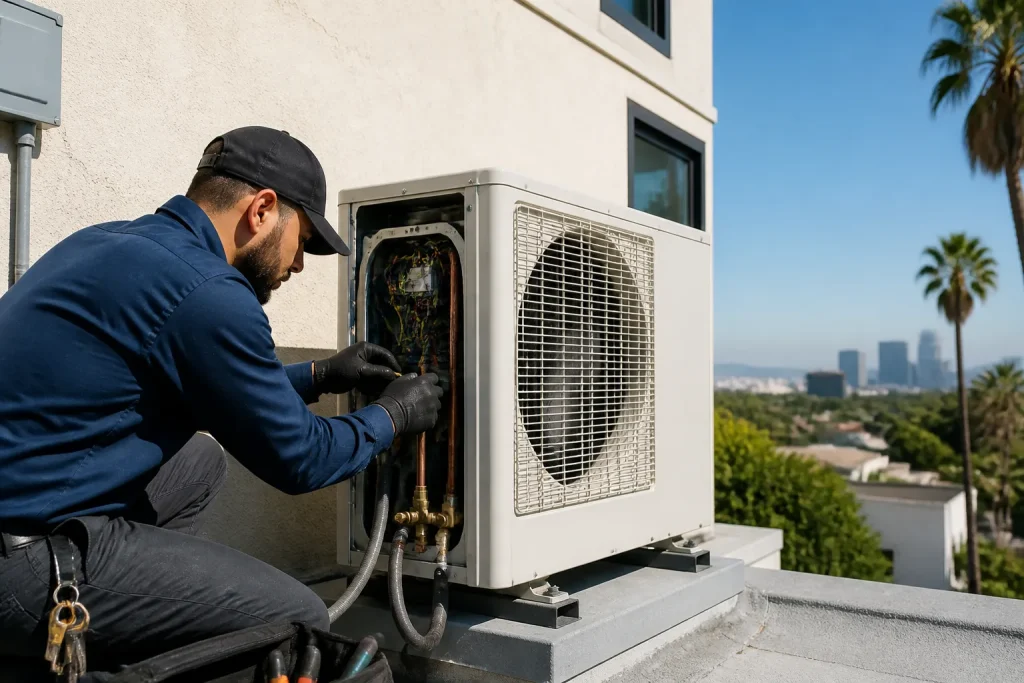
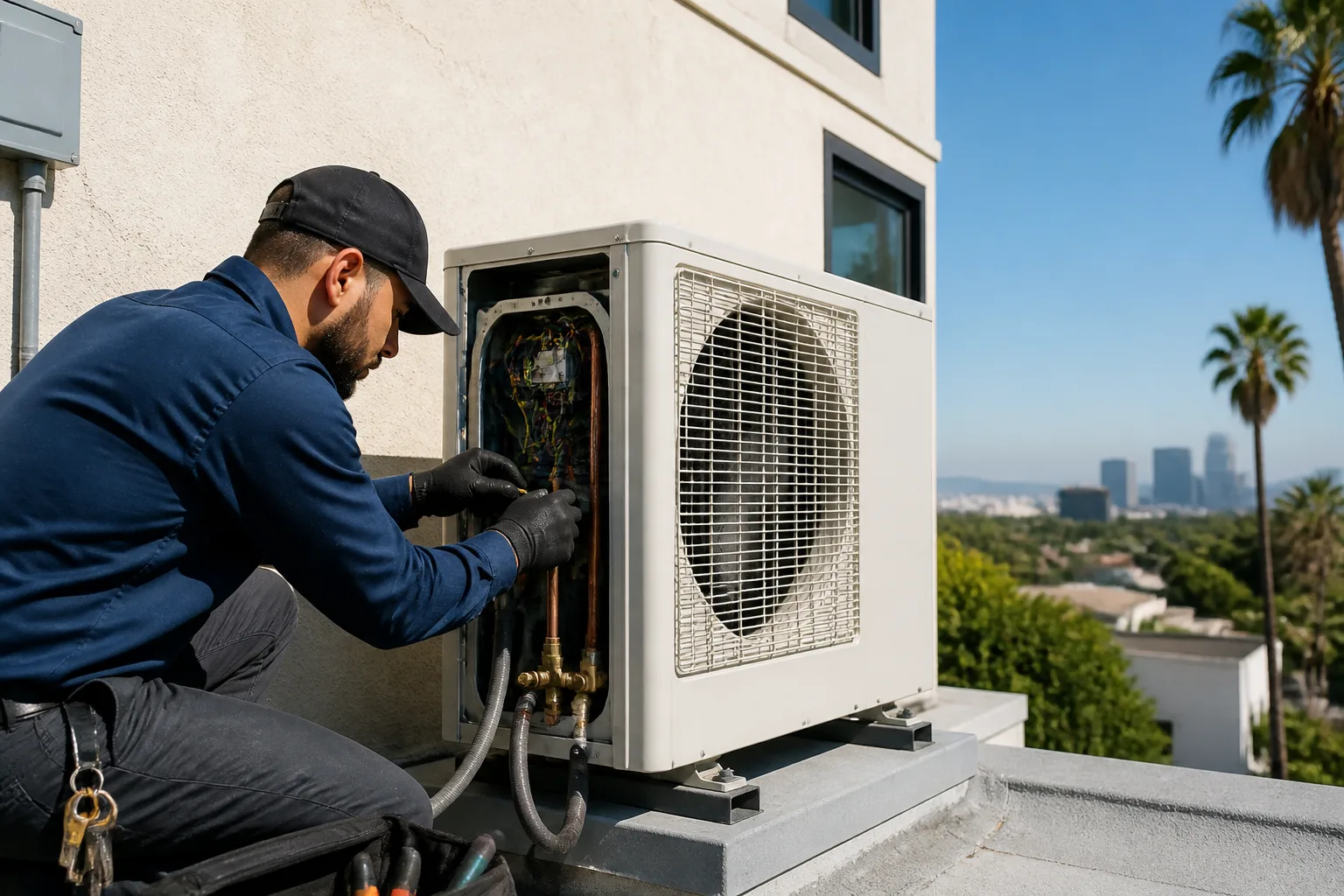
If your Daikin error code points to anything beyond a dirty filter or a tripped breaker, that’s the moment to stop. Inverter systems have high-voltage DC capacitors on their boards that hold a charge long after the power is off. That’s not a warning to scare you; it’s the same advice any responsible technician gives. The DC bus on a Daikin VRV outdoor unit can carry 300 to 500 volts, and it does not discharge instantly when the breaker flips. Opening an outdoor unit and touching the wrong terminal is a life-altering mistake, not a repair.
So if the code is an F3, an E5, an E6, or anything that points to the board or compressor, call us. We’ll read the code with you, ask about the behavior you’ve noticed, and give you a straight answer about whether it’s urgent or can wait until a quieter day. And if we come out, we’ll protect your floors and walkways before we start, because the Cedarwell Care Promise means shoe covers and drop cloths on every visit, and a photo of the clean-up before we leave. You shouldn’t have to choose between a working AC and a dirty floor. You get both.
Related services in Los Angeles: if the diagnosis comes back terminal and replacement makes more sense, our AC Installation in Los Angeles team handles Daikin mini-split and VRV replacements. If your heating side is acting up, we also provide Furnace Repair in Los Angeles. And for a broader look at how we approach all brands, see AC Repair in Los Angeles.
The Bottom Line
Daikin makes a genuinely good system, and its error code system gives homeowners in Los Angeles a real advantage if they know how to use it. Read the code, write it down, and ask any company you call whether their techs have inverter training and Daikin-specific diagnostics. The right company answers that question without hesitating. The wrong company changes the subject.
If you’re in Los Angeles and need help with a Daikin system, Meadowsweet Heating & Air home is here. We offer free estimates for repair work, a written price before anything starts, and a live person on the phone 24 hours a day. Call (747) 966-3037 and we’ll help you figure out what that blinking light is trying to say.
Frequently Asked Questions
Most Daikin repairs in Los Angeles cost between $150 and $1,100 depending on the part. A sensor or drain line issue usually runs $150 to $320. An inverter board replacement runs $500 to $1,100 when the part is locally available. Exact pricing depends on your model and the diagnosis. Call (747) 966-3037 for a written quote before any work starts.
Sometimes. If the failing part is common, like a drain pump, thermistor, or fan motor, and it’s in local Southern California stock, same-day repair is realistic. If the part is a board or compressor on a less common model, the repair typically takes 2 to 10 days depending on parts availability. We check stock before we leave your home so you know the real timeline.
An F3 code on a Daikin system means high discharge temperature, which usually means the outdoor coil is dirty or the system is low on refrigerant. In Los Angeles, this code is most common in Valley neighborhoods during summer heat waves. It’s a “stop using the system and call someone” code, not a “wait and see” code.
If the repair is a board or compressor and the unit is more than 10 years old, replacement often makes more sense, especially because newer Daikin units run more efficiently and carry fresh warranty coverage. If the unit is under 7 years old and the repair is a sensor, drain component, or fan motor, repair is usually the smarter call. We’ll give you both options with written pricing and let you choose.
Written by the team at Meadowsweet Heating & Air.
Need HVAC Help?
Call Meadowsweet Heating & Air - licensed & insured, here with fast after-hours help in Los Angeles.
(747) 966-3037