
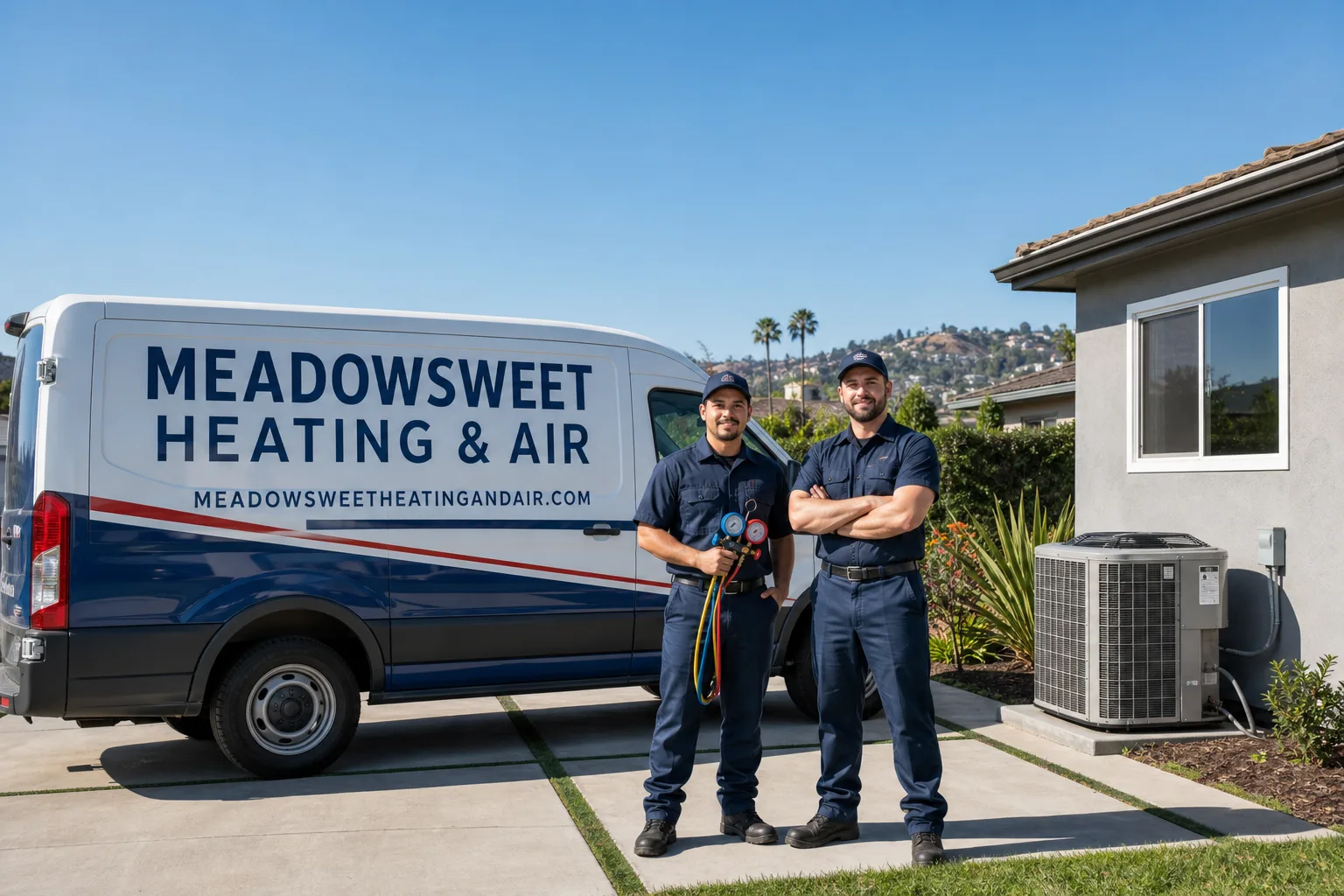
Seasonal tune-up and full diagnostic on your Carrier, Trane, or Goodman system - readings shown to you before any repair is proposed
Diagnosis first, numbers second - you approve the repair price before a single part goes in.







 Before
 After
After Before
 After
After Before
 After
AfterFast, Reliable Furnace Repair Across Stanford
Furnace repair in Stanford typically costs between $150 and $700, and most calls are for gas furnaces in university-owned faculty housing where approval from Stanford Facilities Management is required before any work can begin. That’s the part most HVAC companies don’t tell you until they’re standing in your driveway. We know this because we work inside Stanford’s rules every week. If your furnace is short-cycling, blowing cold air, or making a noise it shouldn’t, call Luis Serrano and the Furnace Repair team at Meadowsweet Heating & Air at (747) 966-3037. We’ll walk you through what’s wrong, what it costs, and what Stanford requires before we ever send a truck.
Why Meadowsweet Heating & Air Is Stanford’s Preferred Furnace Repair Company
Stanford isn’t like Palo Alto or Menlo Park, where a homeowner can call any contractor and approve a repair on the spot. Nearly every residential property here sits on a Stanford ground lease, which means the university has a say in what happens to the furnace. We’ve spent enough time on Stanford’s peripheral faculty-housing enclaves to know which questions Facilities Management will ask, which forms they’ll want, and how to keep a repair moving so your family isn’t left sitting in a cold house for a week.
Luis Serrano leads our Stanford work personally. He’s the one who makes sure a written price lands in your hand before any work starts, and he’s the one who checks that shoe covers went down before our tech stepped onto your floors. The Cedarwell Care Promise isn’t a slogan on our van; it’s the reason our techs carry drop cloths, ask before moving a stroller out of the hallway, and send a photo of the clean-up before they pull out of the driveway. That matters when you’ve got kids doing homework at the kitchen table and a dog who’s already suspicious of strangers.
We answer the phone with a live person, 24 hours a day, every day. No voicemail queue. No “we’ll call you back after the weekend.” If your furnace fails on a cold December night in Stanford, someone from Meadowsweet picks up and starts solving the problem.
Furnace Tune Up in Stanford
A Furnace Tune Up in Stanford costs between $150 and $200, and it’s the single most useful appointment you can book before the heating season starts. On Stanford’s campus-periphery rentals, most furnaces are gas forced-air units from the 1980s through early 2000s, and many have been running for years without a serious inspection. A tune-up means our tech pulls the burner assembly, checks the flame sensor, tests the ignition sequence, verifies the gas pressure, and inspects the heat exchanger for hairline cracks that can leak carbon monoxide. We also check the blower motor and static pressure, because undersized ductwork in the 1940s-1970s ranch homes off Junipero Serra and Campus Drive West pushes blowers harder than they were designed to run.
What you get afterward is a written report and a photo of the furnace before and after. No pressure to replace anything. Our techs are not paid on what they sell.
What our Stanford tune-up actually covers
The burner, flame sensor, ignitor, gas manifold, and heat exchanger. Then we run the full cycle and measure temperature rise across the unit. If there’s a cracked exchanger, a weak capacitor, or a dirty blower wheel, we’ll show you with photos and quote the repair at a fixed price before touching it.
For Stanford faculty housing specifically, we can also flag whether your unit is on the university’s electrification timeline. If Facilities Management is already planning a heat-pump swap, a $200 tune-up that buys you one more winter is often the right call. If the furnace is mechanically finished, we’ll say that plainly.
When to book it
Book before the first cold snap, ideally in September or October. Stanford’s diurnal swing means days in the 70s and nights in the 40s during fall, so furnaces cycle on and off constantly. That cycling is exactly what exposes weak ignitors and dirty flame sensors. Call (747) 966-3037 and we’ll get you on the schedule.
Emergency Furnace Repair in Stanford
Emergency Furnace Repair in Stanford is available 24/7, and the price falls in the same $150 to $700 range as a standard repair. What emergency means here is simple: no heat at night, a gas smell, or a furnace making a banging noise that won’t stop. If you’ve got an infant sleeping in a Stanford ranch home with single-pane windows, a dead furnace at 2 a.m. is a real problem, not an inconvenience. Call (747) 966-3037, and a live person answers.
One thing to know about Stanford nights: the temperature drops hard after sunset, often 25 to 30 degrees from the afternoon high. A house that felt fine at 4 p.m. can hit 55 degrees indoors by midnight. That’s why we keep emergency slots open for Stanford every night during heating season.
What happens when you call
You’ll speak to a person, not an answering service. We’ll ask what the furnace is doing, walk you through a quick safety check, and schedule a tech. In Stanford, our techs usually arrive within a few hours depending on call volume and where you are relative to campus. We’ll confirm whether your property needs Facilities Management approval before we start, so there’s no wasted trip.
Signs you shouldn’t ignore
Smell of gas: shut the unit down, open windows, leave the house, call PG&E, then call us. Repeated tripping of the furnace breaker. Soot around the register. A yellow flame instead of a blue one. Any of these means stop using the furnace and call. Gas furnaces are safe when they’re sealed properly, but a cracked heat exchanger or a bad gas valve is not something to ride out until morning.
Trusted Brands We Service in Stanford
We service Goodman, Rheem, York, and Daikin furnaces, along with equipment from other leading brands. Stanford’s housing stock skews toward Carrier and older Goodman units in the ranch homes, but we’re qualified across nine major brands and carry common parts in our vans. That means fewer second trips for Stanford customers. If your furnace needs a flame sensor, ignitor, gas valve, blower motor, or control board, there’s a good chance we have it on board when we pull up outside your place near Stanford Avenue or Frenchman’s Road. If we don’t, our parts network across the Peninsula gets it in fast.
Common Furnace Repair Problems We See in Stanford Homes
- Gas furnaces retired at 8-12 years old due to electrification rules. Stanford’s binding carbon-neutrality plan prohibits new gas appliances on university properties, so landlords are swapping working gas furnaces for heat pumps long before the equipment is mechanically finished. We get called to quote replacements on furnaces that still have five or six good winters left, but the university’s mandate is the deciding factor.
- High static pressure from undersized ductwork. The 1940s-1970s ranch homes on the campus periphery were built with forced-air ducting sized for heating only. Once residents add cooling or a heat pump, that ductwork chokes the airflow, strains the blower motor, and over time stresses the heat exchanger. We measure static pressure on every repair call because it’s the root cause of a surprising number of failed blowers around Stanford.
- Coastal-air corrosion on outdoor condenser coils. Stanford sits at the base of the Santa Cruz foothills, and marine air pushes over the hills enough to accelerate corrosion on condenser coils and outdoor cabinets in the peripheral enclaves. A coil that would last 15 years in Palo Alto might show pitting and fin decay in 10 here. That affects furnace-tied heat-pump retrofits and any system with an outdoor unit.
- Ignitor and flame sensor failures during fall cycling. Stanford’s diurnal swings mean the furnace runs at night and shuts down by late morning, every day for weeks. Constant cycling is hard on silicon nitride ignitors and flame sensors. We replace more ignitors in October and November than any other two-month window in Stanford.
Pricing for Furnace Repair in Stanford, CA
Furnace repair in Stanford runs $150 to $700 for most jobs. A flame sensor replacement or an ignitor swap lands at the lower end, usually $150 to $280. A gas valve replacement or a blower motor runs $300 to $600. A heat exchanger crack, which is a serious safety issue, can push a repair to the top of that range or into replacement territory, depending on the furnace’s age and whether Stanford’s electrification rules make repair pointless. Here’s the line-item breakdown:
| Service | Typical Price Range in Stanford |
|---|---|
| Furnace Repair | $150-$700 |
| Furnace Tune Up | $150-$200 |
| Emergency Furnace Repair | $150-$700 |
Every quote is written, fixed, and handed to you before any work starts. Estimates are free. Call (747) 966-3037 and ask for Luis.
We Also Serve Cities Near Stanford
The same crews who handle Stanford furnace repair also run calls into Palo Alto, Menlo Park, Atherton, and Los Altos. If you manage a property near Stanford or have family in a neighboring Peninsula town, we’re already working those streets and know the local permitting quirks. One phone call covers all of it.
Serving Stanford, CA - Our Local Coverage Area
We’re based in the Stanford area and know this community well. Use the map below to see our service coverage - if you’re nearby, we can almost certainly help.
FAQs About Furnace Repair in Stanford
Yes, for virtually every residential property on a Stanford ground lease, furnace repair or replacement must be routed through Stanford Facilities Management before work begins. We handle that coordination for you, including the paperwork, the approval sequence, and the documentation Stanford wants before and after the repair. It adds a layer that doesn’t exist in Palo Alto or Menlo Park, but it’s part of living on university land, and we know how to move it along. Call (747) 966-3037 and we’ll tell you what your specific property needs.
Stanford’s binding carbon-neutrality plan prohibits new gas appliances on university properties, which means landlords are being pushed to replace functioning gas furnaces with heat pumps on an accelerated timeline. A furnace that would normally run 18 to 22 years elsewhere gets retired at 8 to 12 here. We quote these early-retirement replacements regularly, and we’ll document the furnace’s remaining life so the landlord has what they need for their records. If you’re a tenant, we’ll also keep you warm during the transition.
Marine air pushing over the Santa Cruz foothills accelerates corrosion on outdoor condenser coils and cabinets in Stanford’s peripheral faculty-housing enclaves. Coils pit, fins decay, and casings rust years sooner than they would in Menlo Park or Los Altos. We recommend corrosion-resistant coil coatings on any new outdoor unit near Stanford, and we’ll inspect the coil condition on every tune-up. It’s the difference between a 12-year unit and an 18-year unit.
Yes. The 1940s-1970s ranch homes on the campus periphery were built with ducting sized for heat only, not heat plus cooling. When we measure static pressure on these systems, we frequently see numbers far above what the blower motor was designed to handle. That stress shortens blower motor life and can contribute to heat exchanger failures. On any repair call, we’ll check the static pressure and tell you honestly whether the ductwork is part of the problem, not just the furnace.
Once a year, every year, before heating season. Stanford’s diurnal temperature swings force the furnace through constant daily cycling in fall and winter, which wears ignitors and flame sensors faster than in coastal towns with steadier temperatures. A $150 to $200 tune-up catches cracked heat exchangers, dirty burners, and failing capacitors before they become $700 emergency repairs. Call (747) 966-3037 to book.
Need furnace repair in Stanford today? Call (747) 966-3037 for a free, written estimate. Luis Serrano and the Meadowsweet Heating & Air team are ready.
Written by Luis Serrano, Owner at Meadowsweet Heating & Air, serving Stanford and the surrounding Peninsula.